The 6 Elements of Recovery

Years ago when I started lifting weights I chose to make fitness a priority. Value I do fitness of body mind spirit finances career and relationships. I see mental health recovery as possible when these 6 elements of the recovery lifestyle fit together in an organic way.

Cheers to living a long life of health wealth and happiness. Each of us can have an abundance of these three things when we realize that we have enough and we are enough.

My overarching goal is to give peers hope. For readers, followers, and audience members to choose hope over helplessness. There’s hope to evolve and grow to find our divine purpose.

Choosing recovery can make all the difference in how far a person can go. My aim is to share stories and teach people to be well. Even living with illness we can achieve wellbeing.

The goal is not to weigh 102 pounds or have six-pack abs. The objective is to live the life you love and love the life you live with despite and because of whatever challenge you face.

Andiamo!

New Focus of Blog

As ever I will talk about physical fitness in the blog. However going forward in this winter season I’m focusing on mental health more so. For a couple of years now I’ve been thinking about the truth: a person who is not in peak health in terms of illness can have a full and robust life.

Acting as a caregiver for an old person I’ve seen firsthand what it’s like for an individual NOT to roll over and passively give up faced with physical limitations.

It’s our mental state that impacts physical disease. Emotional wellbeing really needs to be talked about in what I’ve called in Our One Big Messed Up World.

Our world is beautiful too not just messed up. What’s dis-ordered is what I read in an email newsletter: the use of conversion therapy on individuals who are not heterosexual.

Controlling and trying to repress a person’s identity causes real harm like emotional and mental distress.

Thinking of all this I was keen to take up the cause of mental health. As the stigma of being “different” hasn’t gone away it appears.

For awhile now I haven’t wanted to glorify physical bodies that are in elite shape. So, I will be taking a hard pass on writing anything that insinuates that being in ideal health is the goal.

Becoming and being whole and well while living with illness or any kind of ill-ness is possible. I will focus on this: finding wellness for ourselves while living with whatever challenges we face.

Coming up: recipes that are simple and easy and healthy and tasty to use.

Weight a Minute

The winter issue of Women’s Health magazine features an article with information about how to approach getting the right healthcare.

Fact No. 4 of the article talks about the weight stigma that often prevents women from seeking medical help.

We’re all used to getting on the doctor’s scale pre-visit. Per the WH editors you can tell your doctor to not have the assistant weigh you at all. Or at least weigh you after the exam.

No grown girl should weigh 97 pounds in only a hospital gown when she’s going for a procedure. And even though I weighed 102 pounds recently I don’t think any adult women should weigh less than 110 pounds unless they weigh that much naturally.

And if you’re thin but flabby—what one M.D. calls TOFI (Thin Outside Fat Inside) that’s another thing entirely. Either way the obsession with the number on the scale is terrible. Who wants to be humiliated when an M.D. is fixated on that number too?

Weight sensitivity training and a HAES—Healthy at Every Size approach—should begin in medical school coursework.

Do you know what it’s like to be told you’re too thin? I have. And though I don’t weigh 200 pounds I don’t like people commenting on my weight either. Other women not men are the ones who do this.

I say: tone down the talk about weight. Use reflexive statements as in: “I weigh 155 pounds, and that’s OK.” Instead of referring to how much someone else weighs or used to weigh.

We don’t know their story. The issue I take with the WH Fact No. 4 is that they talk about what if you consider yourself a “normal weight.” I detest that they used the word normal. Even if it was in quotation marks.

The perpetual hang-up people have with being normal must end. Today I don’t weigh 102 pounds anymore and I think this is far better. I’m going to have the Caramel Apple Pie Sizzle dessert at Applebee’s when friends gather for lunch.

What heated me up–and I care even though others think I’m thin–is the Netflix series Virgin River. I watched a couple episodes then quit tuning in. The love interest characters were extremely thin. Maybe like I referred to above they were naturally a lower weight. Okay–fine.

Why can’t we see 200-pound love interests on Netflix?–or anywhere else for that matter. People who love each other love each other. And that’s a beautiful thing in our One Big Messed Up World where people tend to hate and judge in evergreen expressions of belief about the worth of you and me.

Let’s throw the critical caustic comments in the garbage can. Those of us on the receiving end of body-weight barbs shouldn’t have to develop the thick skin needed to let those digs roll off our backs. The haters should not be flaming us to begin with.

“You’d be so pretty if you lost the weight” is not a compliment. It’s like a microaggression. Everyone is pretty darn beautiful even if our pounds are the source of other people’s pain. Why do they care?

This is their problem not ours. So fire away–order the Caramel Apple Pie Sizzle and have fun with friends.

Latest Lower Body Routine

Glute Kicks: on hands and knees extend 1 leg out keeping leg straight lift up to ceiling and squeeze glute 3X 12 reps

Kettlebell Squat: hold 10 pound KBs up by shoulders squat while holding KBs in place no presses 3X 12 reps

Lunges with Front Foot Elevated: Front foot placed on platform with 1 riser holding feet in place lunge right side first no weight 3X 12 reps

Single Side Romanian Deadlift: 10 pounds KB in hand holding on to table or chair lower weight in right hand and raise right leg then switch 3X 12 reps each side

Wall Sit: As long as comfortable

______________________________________________

Ball Slam 15 reps (medicine ball I have 10 pound raise above head then slam)

+

Leg Raises 10 reps then leg tucks 10 reps

Burpees 10 reps

+

Side Plank 15 seconds each side

Latest Upper Body Routine

Body Bar Shoulder Press: Holding bar just below chin press up to ceiling then lower back to start. 3X 15-20 reps

Bent Over KB Row: Holding 10 pound kettlebell in each hand hinge at hips look forward to keep back straight palms up 3X 12 reps

DB Hammer Curls: Palms in curl 12 times then hold for 5 seconds 3X 12 reps 8 pounds

DB Skull Crushers: Lying on floor arms extended bend at elbow then extend back toward ceiling 3X 12 reps 8 pounds

Push-ups on Floor: As many standard push-ups as possible; modify on knees if necessary 3X 12 reps

__________________________________________

V-ups: Bringing both arms & legs to meet in middle 15 reps

+

Crunches: Lift only shoulders to squeeze abs

Butt Kicks: 20 seconds

+

Scissors for Abs: Bring legs over one another

Finding Good Habits

I’m pulled in a magnetic way to buy special edition magazines. To read to get information that can help me have a better life.

The latest issue was the Real Simple Finding Good Habits: Simple Keys to Feeling Happier, Healthier, and More Fulfilled. I quote from the guide to encourage followers to buy and read it.

Though I haven’t read every article yet one stands out about The Power of Habits. In the feature it describes making your bed in the morning as a “keystone habit.”

In fact if this can be believed:

“Bed making is correlated with better productivity, a greater sense of well-being, and stronger money management skills.”

Do millionaires make their beds every morning then? Could this be a hidden secret to wealth-building?

In Small Changes Big Results:

Adding a tiny micro-habit to our daily routines can give us joy. Rather than take a once-a-year Cozumel vacation to an azure beach (that we might not afford to pay off) happiness can be had for a song every day of the year for free or low-cost.

One study reported in the article that adding a food ritual can help us. It’s why wine drinkers who swirl their glass before drinking are apparently more satisfied.

Making it convenient to perform a habit is the key. Fill a 23-ounce aluminum water bottle before going to bed. Keep it on your night table. Voila–it’s easy to start the day with imbibing what I’ve called The Drink of Life.

One last key factor in this second article is to Rework your vocabulary. Quoting Seattle-based life coach Patricia Love: Repeating the phrase “I choose” or “I get to” “helps shift us into a happier state.”

Reworking our vocabulary this way can get us to see a healthy habit as a positive choice we’re making not a burden. This is why I believe too that not using the vocabulary of “I have to” is the key factor in transforming how we view what we need to do.

Framing what we need to do as something we want to do is the difference.

In the end changing our perception from negative to positive is what it’s all about. Those rituals we engage in might just keep us happier, healthier, and more fulfilled.

One habit I have is using a different ceramic mug each season to drink water from at the dining table with meals. I choose a mug whose color complements the table decor. This subtle change keeps me motivated to drink the water with every meal.

I’ll end here with this:

Like with anything I’ve recommended you could be fearful of doing something that appears to be strange or out of the ordinary. It can be unsettling for some of us to think that others will think we’re not normal. The question is: Why should we care about people who don’t care about us?

Our health and wellbeing count more than others’ opinion of how we choose to live and what we choose to do. If they’re really interested in being healthy, when they see how effective we are they’ll want to copy us!

Cooking as Therapy

The photo is an image of a recipe in Cooking as Therapy book.

This month I checked out of the library the new book published last month: Cooking as Therapy: how to improve mental health through cooking. Each chapter on how to heal what you feel features three recipes: a Fast Lane, Easy Rider, and Scenic Route that take 5 minutes, 30 minutes, and an hour respectively.

You’re supposed to wash your hands before you begin and I forgot this.

In Session Four: Surviving Sadness I used the Fast Lane: Top It All Off Treat. I chose this recipe first not because I was depressed. Anyone who’s feeling ordinary sadness or is grieving could follow this recipe.

The ice cream sundae in the photo above is what I created to Top It All Off as my Treat. Who could resist having ice cream as a form of therapy?

In each chapter the author who is an LCSW features recipes she’s preplanned for readers to use. At the end of the book she gives readers a list of food ingredients and methods for using the food on your own. To create unique recipes customized to what you’re going through.

I recommend installing Cooking as Therapy on a Kindle or iPad or checking it out of the library if you can’t afford to buy it.

A library is a free college of knowledge. And hey today if you return a book late as long as it’s checked back in a lot of libraries will remove the fine you incurred.

I’m going to Top It All Off again every so often. My first foray into doing this sparked an ingenious idea I had for a celebration to host at the beginning of the year like Kwanzaa only for individuals living in recovery.

Stay tuned for the details on this coming up.

The Life-Changing Magic of Individuality

Just reading about getting organized might throw some people into shame. To counter this I wanted to write in here about the life-changing magic of individuality. Of being imperfect beings with our beautiful quirks and traits and personalities.

Some of us are not really able to adhere to an always-tidy life ethic or living space. This is why self-acceptance comes in handy. Having the radical grace to accept that you’re doing the best you can with what you were given on any given day.

As the choice belongs to you and me whether we even want to change a certain behavior or can live with it.

Life is a dialectic state of being and doing. It’s not an “always” and “never” proposition of how to live. We can connect separate areas of our life with “and” as in “I’m neat at times and messy at other times.” Or even like this: “I’m happy and sad.”

Like a woman told me decades ago: “Perfection is a myth because it implies there can be no growth.” If we reached an ideal state that would be the end of our self-development.

Far better to believe that everyone’s work is in progress and that change, and growth are lifelong endeavors. Like I coined the approach decades ago the way to go is to give yourself a lifeline, not an impossible restrictive deadline.

Truly beauty lies in the imperfect. There’s a moral in the story of the Leaning Tower of Pisa in the town of Pisa far off in Italy. The tower is leaning because multiple engineers designed and crafted each level of the tower over decades. Thus the building turned out leaning not straight.

Tourists flock to Pisa to see this magnificent imperfect structure that defies the logic of traditional architecture.

Ideas I give in this blog I seek to be a springboard for followers to consider. I intend that you can take my humble words as inspiration to find what works for you and to create your own methods too.

Get Organized Month

New Year’s Eve is approaching quickly. The time to set a resolution that I think should be easy to achieve.

January is Get Organized Month all month. Per Google the focus is: Decluttering physical spaces, optimizing schedules, creating better habits, and boosting overall well-being. The themes are: Often ties into New Year’s resolutions, emphasizing fresh starts, productivity, and managing stress.

What better time than at the beginning of the year to Bring in the New Go out with the Old. I’ll write soon about ideas I have for getting organized in January.

The first article I ever published was in the Women’s Forum of the local newspaper in January 1990. The column I wrote was titled Time to Start Spring Cleaning.

I was the first person back then to make the connection that the beginning of the year was the ideal time to clear out the mental cobwebs in our head as well as the physical clutter in our home.

Clearing out the clutter in January and “cleaning up” our negative thoughts about what we’re capable of are habits that can serve us well at this time of year.

The last sentence of Time to Start Spring Cleaning was: And when you open up a can of chowder you might just discover a whole new you.

Cheers! To having the courage to express ourselves. To having the capacity to let go of what’s no longer serving us. To having a life unencumbered by the stuff weighing us down.

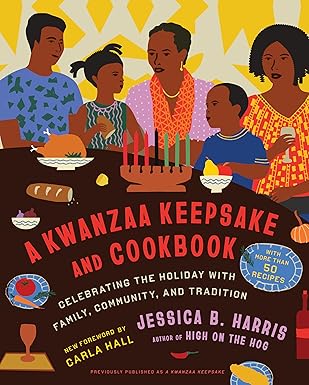
Kwanzaa Keepsake and Cookbook

Image of Kwanzaa Keepsake and Cookbook Book

I checked the book above out of the library. A Kwanzaa Keepsake and Cookbook by Jessica B. Harris is a short hardcover that packs everything essential into the guide to the celebration.

The First Night: Umoja for Unity.

The Second Night: Kujichagulia for Self-Determination.

The Third Night: Ujima for Collective Work and Responsibility.

The Fourth Night: Ujamaa for Cooperative Economics.

The Fifth Night: Nia for Purpose.

The Sixth Night: Kuumba for Creativity.

The Seventh Night: Imani for Faith.

Each night’s chapter has info, recipes, a project at the end, and blank lined pages to write in your own recipes and recollections.

While a White American won’t celebrate Kwanzaa I’m fond of how a holiday like this was created for Black Americans to celebrate. Sharing community meals is what’s needed at this time in history where things seem to be going backwards in terms of others giving you and me and everyone else dignity.

We each of us should be proud of our culture and our heritage regardless of whether others hold us in high regard or don’t when we’re of that background.

I’m going to create a festival for those of us living in recovery to celebrate at this time of the year. We should have our own gathering with themed days.

You can like I did check A Kwanzaa Keepsake and Cookbook out of the library. Some of the recipes feature vegetables not just meat which can be good for vegetarians or vegans who celebrate Kwanzaa.

Coming up reflections on the New Year and setting resolutions that we can actually keep. My thinking is that a New Year’s resolution should be easy to get done. It’s the ideal time to focus on Who we want to Be not just on What we want to Do.

Atomic Changes

A wise woman asked me to think of this:

“Where might a small change in my routine or habit create more energy?”

I opted for drinking a 23-ounce aluminum bottle of water every day at or near 7:00 a.m. consistently.

This is a question I think everyone should ask ourselves when we’ve reached a plateau.

And hey, I was excited to think that a shot of espresso in a tiny cup could lift fatigue.

It can be hard to change or break negative behavior. The book Atomic Habits is out of print however it’s likely available as an e-book or to check out of the library.

At the end of this James Clear guide is a two-page summary of the specific ways to replace an old habit with a new one.

Atomic habits I think are the ones to shoot for before things reach the point of requiring a drastic overhaul of everything all at once. Which is an impossible feat to accomplish.

Engaging in micro-habits to begin with if you ask me is the way to sustain the lifestyle and spark your motivation to continue.

This is where filming and living life in a slow beat production counts. To rush, cut corners or take shortcuts is a halfhearted approach guaranteed to be shoddy and precarious.

In the long run it’s always wise to take the long view if you ask me. Using the 90-day action plan in the book Changeology: 5 Steps to Realizing Your Goals and Resolutions could be the start of long-lasting or forever-lasting behavior change.

What if what you and I want to do is start something new and not replace an old habit? What if there’s nothing you want to change only a habit you want to add?

I like Google’s AI response. Per Google:

To start something new without replacing a negative behavior, focus on adding positive actions via habit stacking (linking new to old habits), starting incredibly small (micro-habits), changing your environment to support the new, and using mindfulness to build awareness, making it about growth rather than removal, with supportive plans and celebrations for progress. 

I wasn’t a fan of using Google until its first responses turned out to be excellent AI information that I could really use.

A small change is like an atomic habit. If we can micro-dose our happiness in tiny joy “snacks” each day as one expert calls them why not micro-dose the goals we have in smaller steps in the form of daily sub-goals?

More on these ideas coming up in a review of National Get Organized Month in January.

First coming up here a review of a new cookbook that if I remember right has just come out this fall.