Exercise May Reduce Cancer Risk

A research study indicates that exercise may reduce the risk of 13 cancers.

Maintaining a healthy lifestyle could decrease cancer deaths by 67 percent for men and 59 percent for woman.

A healthy lifestyle could lower the discovery of new cancers by 41 percent in women and 63 percent in men.

As defined a healthy lifestyle is one where a person doesn’t smoke, doesn’t drink too much, maintains a body mass index between 18.5 and 27.5, and exercises 75 to 150 minutes weekly.

Seventy-five minutes of vigorous exercise or 150 minutes of moderate exercise counts in this number.

I strength train two or three days a week for the most part. It adds up to between 80 minutes and 150 minutes.

Today I received a CSA box–a box of community-supported agriculture produce items from a local farm. The produce I bought is organic. There’s enough in the box to create three or four “vegetable” sides for three or four meals.

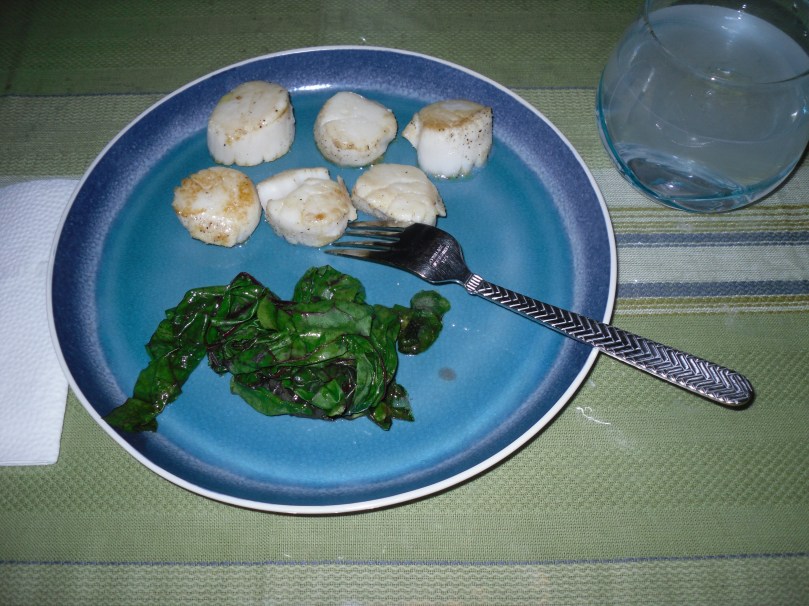
The photo below shows one dinner with local dry sea scallops and red chard. You can simply heat up olive oil in a saute pan and cook the red chard until it’s wilted yet not too dark. The sea scallops can be cooked for five minutes on each side with a little salt and pepper and garlic powder.

Here’s a nutrition fact you might not know: scallops are a good source of Omega-3 fatty acids. And the red chard–well greens in any form are always good.

This dinner is quick and easy: it takes only 10 minutes total to cook the items.

scallops red chard


Pantry Staples

In the book What the Fork? Stefanie Sacks lists common food items and where and for how long you can store them. In Real Simple magazine a number of years ago it featured this kind of cheat sheet in a more detailed fashion.

This got me to thinking what kind of contemporary healthy kitchen a person could stock to make it convenient to eat more nutritious food. Ideally, on nights when you’re too tired to cook there should be better alternatives to some kind of soggy sugary flakes cereal.

Indeed: it’s been years since I’ve resorted to having cereal for dinner. You can click on the recipes category to find simple to prepare meals that can stand in for that ubiquitous cereal-for-dinner lassitude.

See if having on hand these staples would make it easier to cook more healthfully and also when we’re low on money:

Refrigerator:

Eggs – 1 month.

Butter – will last 3 months unopened and 2 weeks opened.

Sesame oil – will last 6 months

Maple syrup – will last 1 year opened.

Mustard – will last 1 year opened.

Deli olives  – will last 2 weeks.

Broth – will last 4 days.

Salad dressing – will last 1 month.

Pasta sauce  will last 4 days opened.

Pantry:

Honey – will last 1 year opened or unopened.

Hot sauce – will last 2 years.

Onions and garlic – will last 2 months.

Canned beans – will last 9 months.

Pasta – dried – will last 2 years.

Olives – jarred – will last 6 months unopened.

Pasta sauce – will last 9 months unopened.

Vinegar – will last 1 year opened – 2 years unopened.

Olive oil – will last 6 months opened – 1 year unopened.

(All other oils should be stored in the refrigerator. They can keep in a cool fridge for 1 year.)

Salad dressing – 1 year unopened.

This is good news because if you stock a pantry with these items you can buy salad greens and then use the olives and salad dressing and chick peas or other beans in the pantry to create a salad.

You can also use the eggs to create my Baked Eggs in Tomatoes recipe. (In season in the summer or out of season at other times.)

I’m not going to judge a person who eats meat. I’m not going to judge a vegan either. Each of us has to do what makes sense for us. A lot of the information I’ll be writing about was gleaned from What the Fork? by Stefanie Sacks.

I’m not going to say “read it and heed it” for anything I write or what I refer to from a book. I’m simply like a librarian giving information.

You can see if it makes sense.

I write about fitness and nutrition now because it’s high time someone living in recovery came out and wrote in specific detail about these things.


Fifty and Beyond

I turned 51.

Fifty and beyond can be beyond measure.

I’m confident when I tell readers that life can get better as you get older.

It’s time to discard the old, the outgrown, the outdated.

Life demands that a person is open to what is possible for us at mid life.

I have a guy companion now. He appeared in real life like a soul mate. Not by checking off a list of traits on an Internet dating website to see if a guy matched every criteria.

Those guys’ photos on OKCupid look like mug shots.

The point is not that your soul mate has to be a wife or husband or other romantic partner.

I’m writing another book and in it I talk about a book at a library that talked about women’s sexual fluidity. I haven’t seen anywhere else on the Internet or in the mental health literature or in any other blog or in a blog featured on PsychCentral or elsewhere talk about sex and relationships in this kind of detail.

What’s often commiserated about is the idea that so-called normal people you take on a date think you’re “crazy” when you reveal you have a diagnosis. That’s so over.

Sex and relationships and talk about these things doesn’t have to be brought back to relating to the diagnosis if you don’t want it to.

What’s not talked about and should be is how income limits a person’s options more so than anything else.

Some women judge men by their ability to take them out for a 3-course steak dinner that costs at minimum $60 dollars. A friend had a woman chew him out because he didn’t take her to a high-end restaurant that cost at least $100. She thought the $60 he paid was too cheap. How offensive is that chica if you’re doing that–I think very.

Finding someone who’s compatible is not easy for a lot of us and it often has nothing to do with having a mental illness. If you’ve browsed OKCupid lately you’re aware there’s plenty of fish in the sea however most of them you wouldn’t want to swim near.

Becoming obsessed with finding a boyfriend or husband and settling for the wrong guy is a mistake.

At 50 and beyond we have the power–and women too have the power–to choose to focus on our heart’s desire.

Which for some of us might be walking down the alter and for others might be staying at home knitting a sweater.

I was supposed to write altar in that last sentence. Though alter can describe the kind of life some of us live.

I have seen no one else talk about this fluidity anywhere else. I have seen no one else talk about how income limits a person.

I have only seen in one other place a writer make the case for finding your true soul mate.

It was in the March 2016 Oprah magazine where a feature article talked about how a soul mate can be a friend or even a sweater or other article of clothing or a work wife or work husband as the expression goes.

It is time to talk about these things. It’s time to dispense with the usual discourse. It’s time to talk about having the courage to do your own thing–whatever your thing is–without fear of reprisal.

And if you don’t want to talk about illness except in a bare-bones way to the people you meet I say: go ahead–be discreet.

Judging other people is a crummy thing to do yet all too often it goes on and more so against people with mental illnesses. For reasons that are totally arbitrary.

Which is why I think each of us needs at least one soul mate who gets us on a divine level even if it’s not a physical level.

Inspiration for Living in Recovery

I have a friend/companion. We sit at an outdoor patio. We go to Starbucks. We attend poetry readings.

Wherever we go the talk often turns to recovery. Not a lot of people would be so open in places where others can hear you. It’s refreshing–and-life affirming–to have a companion in an almost soul-mate kind of way.

I firmly believe a soul mate doesn’t have to be only a wife or husband–a soul mate can be a member of your tribe. We talk about the Sonic Youth albums in our collections. Everywhere I go I’ve met someone entranced with the music.

I value that illness holds only a minor place–because I choose to focus on the life that is possible after a break. I’ve lived through the worst– I recovered.

A woman on the Internet who uses a fake name didn’t understand why I identified as a person diagnosed with schizophrenia. I identify as a person who had a breakdown–what’s commonly diagnosed as schizophrenia.

Yet the point isn’t that once you’ve recovered you should go your merry way. By all means: only if you want to go your merry way do so without guilt.

I decided to become a mental health activist because of the cost of untreated mental illness in America–upwards of $192 billion. I’m an activist because of the untold cost in wasted lives–in the loss of human capital.

Everyone deserves to have a full and robust life–not just a lucky few who get the right treatment right away. I advocate that you can have a full and robust life because no one who has crossed over should despair that they can’t come back.

I advocate–and I always will–for recovery for everyone.

Dr. Martin Luther King Jr. is quoted:

“Everyone must decide whether to walk in the dark of destructive selfishness or live in the light of creative altruism. Life’s most persistent and urgent question is: what are you doing for others?”

My goal in this lifetime is to be an inspiration.

Your hell doesn’t have to go on forever.

Making Changes at Mid Life

The takeaway–the life lesson– is that our lives aren’t over until God says they’re over.

Finding our right work–vocation–livelihood is like trying all the keys on a chain to see which one unlocks the door to true happiness.

Readers: I failed big time at a lot of things. I spent five years in the gray flannel insurance field just starting out–that’s my number-one infamous claim to having failed.

Getting to mid life gives us the chance to reexamine our path. It’s not ever too late to take action in the direction of our dreams–or in the direction of a new passion that arrives later in life.

I went to graduate school with a woman in her sixties–yes, she was going to school at 65!

I say: risk change–believe in tomorrow. I will talk soon about how one daring act when I was 46 totally turned my recover around for the better.

It’s not ever too late to make a positive change and see results.

Fifty and beyond is prime time.

I’ll tell readers now and always: set your sights higher. As best you can, refrain from believing anyone who tells you there’s no hope that your illness can get better.

Our lives can change for the better at any point along the way.

In the next blog entry I’ll tell you how I’m confident beyond a doubt that this is possible. I’ll talk about how other people have made this happen.

Schizophrenia Recovery at Mid Life

I turned 50 last year. It’s a time that’s so challenging for a lot of us–yet it helps to see our lives in a cheer-view mirror not a rear-view mirror.

It’s a life lesson to realize that as I wrote here and elsewhere we should give ourselves a “life line” for making our goals real instead of an impossible must-do-it-by deadline.

Face it: at 50 a lot of us mourn unrealized dreams. We should be embracing the future and living in the here and now instead. Always an alternative exists that is just as good as the original goal.

I had wanted to get a diploma in image consulting from FIT. This dream disappeared quickly along with my idea to take up running that could’ve been stamped DOA–dead on arrival too.

Whatever happens, we’re not always going to achieve a goal we set. We can end it with grace and move forward with the courage and resilience to choose a new goal.

This is because our lives aren’t over at 50. It’s a myth that EVERYONE diagnosed with schizophrenia dies 25 years earlier. A MYTH. My friend is 72 and has taken SZ meds since he was 13. I kid you not–he’s 72.

The life lesson I give readers is to not give up on yourself or settle for the path of least resistance.

There’s still time to make positive changes and see the benefits of improving your life no matter where you are in your recovery or how far you think you still have to go.

I say: act with grace and kindness towards yourself and others. There’s still far too much ongoing hate and violence in the world. We shouldn’t be giving critics and haters the power to influence how we feel about ourselves.

In the coming blog entries I will continue to talk about recovery at mid life.


Non-Traditional Work

I have famously celebrated Rite Aid cashiers in this blog and elsewhere.

An old SZ magazine news article of years ago talked about what to do if you have negative symptoms or other limitations that make paid employment not viable.

The analogy was that if you like to play guitar you could join a band. If you like to write you can try to get published in literary journals. And so on. And so on.

I have often made the case that only valuing work that contributes to the economic stream in society effectively undervalues people whose humanitarian work–and often the work of recovery–DOES COUNT as a worthy endeavor.

One of my saddest things is that parents with adult kids who are diagnosed with schizophrenia often have to mourn the loss of the son or daughter who isn’t going to be the M.D. or J.D. they hoped.

My contention is: it’s not our parents’ choice that should determine what we do in life.

I’ve been told of a woman who bakes cakes. I’d be willing to take the risk to pay her $100 to bake me cakes to take to a holiday party. Her father is disappointed that all she does is bake cakes. The identities in this story have been changed yet you get the idea.

I don’t value paid employment because I’ve worked with rude or lazy co-workers so I can assure you a robot could do their job better. It’s unfair yet they remain employed. I don’t hold these people up as role models. Ordinary people diagnosed with schizophrenia who get up every day and struggle to get out of bed are my true heroes.

I value the gifts people were given at birth to use to better ourselves and others in the world. Using the gifts we were given and not squandering them is indeed the foolproof way to have a full and robust life–regardless of whether you’re paid to do the work you do.

This is where I’m going to end this series of career blog entries. It seems I’ve detailed this as specifically as I can right now.

Stay tuned for topics in April related to finding joy in living in recovery at mid life.

Creating a Vision Board

I’m writing a second book that I hope to publish within three years hopefully more like within two years.

One aspect of this I might feature is creating a vision board which I think is useful unlike certain critics of doing this.

My own vision board stands against a wall in the hallway. I tacked to it photos, postcards, and magazine advertisement–along with fortune cookie fortunes like “Fate Loves the Fearless” and “A Goal is a Dream with a Deadline.”

Anything goes in decorating a vision board. You can use a concert ticket, fabric, ribbon, most anything to visually represent a goal you have for your life.

I recommend viewing the board once a week.

While it can become wallpaper, a vision board is also an enduring visual memoir of the person you are and who you aspire to be.

For that, it can’t be beat. The vision board can certainly cheer you every time you see it–like a little thrill to discover yourself and your potential.

The color red and strong women in chic clothes figure in my own board.

This is just an idea for a tool for growth and change. Oprah Winfrey was a big fan of them years ago.

I’d be happy to hear from readers if they created a board.

Goal Setting in Recovery

I make the case for setting goals. Instead of allowing yourself to be blown in any direction like a weather vane. Setting and reaching towards goals if you ask me is one way to have joy and contentment in life.

It’s possible that a person can be truly happy watching TV all day every day for the rest of their lives. I’m not that person. I’m not going to judge a person who watches TV all day. I’m not going to judge a consumer who is insecure about their abilities in relation to people they think are superstars who have it easy.

This is my point exactly: life isn’t easy. Life can be hard at times. Life is hard for everyone even if they don’t let it show. Taking control by setting goals to work toward gives our lives a purpose and a power greater than our pain.

If you ask me there’s a benefit in “picking the brains” of successful people to see how they did it so that maybe we can learn from them and create our own success in our own way.

The point is that we don’t have to copy that person exactly. We can take ideas and translate them into our own mode.

One example is that I tear out fashion advertisements from magazines and insert them in a fashion binder. I won’t be able to replicate the exact look yet when I go in my closet I can create a similar look or mood with clothes I already own.

In this way too we can fashion a lifestyle that works for us. The Aveeno skincare advertisement tells us: “The best way to predict the future is to create it.”

This is what I’m saying: we can create a better life for ourselves when we take action every day in the direction of our dreams. That’s goal-setting in its simplest form. It can start by writing down a To-Do List–the simplest form of setting a one-day goal.

I wrote about goal setting at HealthCentral years ago. I’m no longer the HealthGuide there so I won’t link to those news articles. I will continue in here to pick up where I left off there.

Tennis champ Serena Williams I’ll quote here again:

“You have to believe in yourself when no one else does. That makes you a winner right there.”

Like I said it’s possible to start out with the mindset that you can achieve a goal instead of talking yourself out of doing something.

I believe it’s possible to have a full and robust life. I believe that people diagnosed with schizophrenia bipolar and other mental illnesses have the potential to create a better life for ourselves.

I’ll end here by saying that tearing pictures out of magazines is a great way to begin. If you want to move into your own apartment post where you can see it every day a photo of an apartment from an interior design magazine.

Creating a vision board is another way to visualize your goals. I’ll talk about this next.


Getting Mentally Strong

I see things differently.

As the prelude to talking about careers I want to limn the number-one secret to success in recovery and in life: getting mentally strong and engaging in goal-seeking behavior.

I wanted to talk about this after listening to the end of an interview with Amy Morin, LCSW on the radio. She said that mentally strong people refrain from talking about what they can’t do.

The interviewer asked her if this stigmatizes people with mental illnesses. The therapist said “No” because everyone living on earth has potential. Morin referenced Marla Runyan, the legally-blind athlete who competed in and won races in track and field. From Wikipedia:

“Marla Runyan…is a three-time national champion in the women’s 5000 metres.”

Do you really want to compare yourself to other people? Being jealous of other people is not the way to live our lives. We shouldn’t compare ourselves to ordinary, average people because to do that would be lowering our expectation of ourselves to conform to people who aren’t driven to excel.

Think about it: we’re capable on our own of doing great things and setting the world on fire. You and I have it going on in our own way. Other people who are content not to strive to have a better life shouldn’t be our benchmark.

No one else holds us back: only ourselves. I make the case for setting our sights higher and dreaming bigger and setting challenging goals.

To this end in here I’m going to talk about setting goals in the next blog entry.

My secret is simple. Instead of telling myself “That’s impossible!” or “I won’t be able to do that!” my first automatic response is “How can I make this happen if I really want it?”

I urge readers to take up this question: “How can I make this happen?”

Imagine: a woman who was blind competed and won in track and field.