My New Year’s Goal

The science is clear: people can and do keep New Year’s resolutions.

How is this possible? They start and follow through on a 90-day action plan.

The action plan is executed in a step-by-step fashion. Each stage of the plan must be followed in a specific order: Psych Prep Plan Perspire and Persist.

Following the steps out of order or getting stuck in a certain step–a step mismatch–makes it harder to achieve your goal.

The bulk of the action plan occurs over two months where you’re actively engaged in the new behavior.

You can read the book Changeology: 5 Steps to Realizing Your Goals and Resolutions to see how it’s possible to yes keep a New Year’s resolution.

It’s available as an e-book so you can install it on your iPad or other device.

The author reminds the reader that drawing upon outside support is crucial in making your goal happen.

My goal is to eat more healthful food six days a week.

To this end I have signed up for a meal delivery service.

I’ve ordered chicken with diced sweet potatoes and Brussels sprouts, turkey with mashed turnips and broccoli, a side of sweet potato wedges, a side of broccoli, and a side of Brussels sprouts. Plus an apple muffin and chocolate avocado balls and pancakes.

I will report back in here how the food tastes. You simply heat-and-eat the food so there’s no long arduous prep time to get the meals ready.

It’s the KettleBell Kitchen service and available in the New York City area.

I will report back this weekend on my experience.
New Law Seals Up to 2 Convictions in NY

A new law in New York seals up to 2 convictions for non-violent and non-sex offender crimes

According to the Wall Street Journal article:

The law will let New Yorkers apply to seal up to two convictions, including one felony, for crimes other than sex offenses and violent felonies, starting 10 years after their sentencing date or release from prison.

MacMillan, ThomasAuthor InformationWall Street Journal, Eastern edition; New York, N.Y. [New York, N.Y]06 Oct 2017: n/a.


New Year’s Resolutions

It can be hard to go outside in the arctic chill when you live in the Northeast. Our minus 2 degree temperature requires staying inside our apartments and houses.

I say: plan your goals today and execute them in the early spring.

Better yet use your birthday as the start-date of a goal-setting plan.

To better be able to achieve your goals read the book Changeology: 5 Steps to Realizing Your Goals and Resolutions.

The author details a proven method for making lasting changes.

It requires a 90-day commitment. This method is what successful people use to carry out New Year’s Resolutions.

I will talk more in coming blog entries about this kind of goal-setting.

For now I say: stay inside and keep warm. Only go outside in this freezing chill when you absolutely have to. Take car service instead of having to wait for a bus when you can afford to do so.

New Year New Hope

The New Year is here.

This year 2018 offers new hope for all of us to move closer to what we want to get in our lives.

My literary agent will soon pitch to editors a second nonfiction book.

Stayed tune for information about this in early February.

Over the last 3 weeks I’ve been writing fiction. I would like to publish this first novel within 3 years along with the second nonfiction book.

Three weeks ago the novel was only 60 pages and today it is 225 pages.

Yes–it’s true–I haven’t ever had writer’s block. Alas, I often get in “the flow” of inspiration. At all hours of the day and night images and sentences and dialogue come into my head quickly and freely.

It can be eleven o’clock at night and I’ll be struck with inspiration and have to get everything written on paper.

The idea of being in “the flow” state as has been described in the literature is a myth.

Getting struck by inspiration at all hours of the day and night is actually akin to being locked in a cage unable to get out.

You don’t know when this “flow” of ideas is ever going to stop.

You get your trusty pen and hardbound journal. You start writing one sentence and then another sentence. Then you’re writing other sentences and this madness doesn’t stop until three o’clock in the morning.

For someone possessed with this kind of gift “the muse” commands you to keep writing and not stopping.

You write and write at all hours of the day and night.

That is how I have come to start writing my first novel.

That is how I have come to have written a second nonfiction book.

My goal is to publish the second nonfiction book this October 2018 which is Disability Employment Awareness Month.

The book is a school and career handbook for mental health peers.

I will tell you more about this book in early February.

In the coming weeks I will talk again about setting goals and resolutions.

Happy New Year!

Holiday Season

I want to write about the holiday season.

At my Left of the Dial blog you can read about my experience with the United States Postal Service.

In here I want to talk about how the holidays are often hell-idays for a lot of us living with a diagnosis.

I lost my father in January 2016. I lost a beloved aunt in March of this year.

You are not alone if you are actually depressed at this time of year and not in a good mood during the festivities.

What can help us feel better when we’ve lost our loved ones or otherwise don’t feel like celebrating?

A modest amount of retail therapy could help. Doing a bout of spring cleaning now might seem counter-intuitive yet it might help too. Helping others by volunteering at a soup kitchen could help you.

My friend who is a soul mate to me I really think he is told me:

“Just be a good person and do good.”

That was his advice for helping yourself overcome having a hard time.

Just be a good person and do good is what I urge my loyal blog readers to adopt as a life ethic.

When all else fails, strive to get at least 7 hours of sleep straight through every night as often as you can.

I will end this blog entry by thanking you for reading this blog.

I’ve reached 5,000 visitors so far which is a great thing.

Gracias. Merci. Grazie.

A million thanks.

Ongoing Psychiatrist Questions

Questions to Ask Your Psychiatrist (Ongoing)

  1. What is my diagnosis and how did you come to that conclusion?
  2. What medication do you propose to use? (Ask for the name and dosage level.)
  3. What is the biological effect of this medication, and what do you expect it to accomplish?
  4. What are the risks associated with this medication?
  5. How soon will we be able to tell if the medication is effective, and how will we know?
  6. Are there other medications that might be appropriate? If so, why do you prefer the one you have chosen?
  7. What are the side effects of the medication? How long should I “wait out” any side effects before calling you?
  8. Are there other medications or food that I should avoid while taking this medication?
  9. How long do you expect me to be on this medication?
  10. How often will I be seeing you until the medication takes effect?
  11. If I’m taking more than one drug, when and how often should I take each one?
  12. How do you monitor medications, and what symptoms indicate that the dosage should be raised, lowered or changed?
  13. Are you currently treating other patients with this illness?
  14. What are the best times and what are the most dependable ways for getting in touch with you?
  15. What do you consider an emergency if I have to call you after hours?

Feel free to add your own questions.

New Psychiatrist Questions

New Doctor Questions

  1. If I need to call you, how long do you usually take to respond?  Do you have another doctor on-call if you’re on vacation?
  2. If I ask you questions, will you give me detailed information about why you think I need a certain treatment? I need to know the rationale behind your suggestions.
  3. What drugs do you frequently prescribe to your patients? Have you had success with these drugs?
  4. How much experience have you had with atypicals?
  5. Will you prescribe drugs “off-label” if you think it will benefit me?
  6. Will you discuss any side effects of the medication you’re treating me with, and do you have a plan in case I develop a side effect?
  7. Is your focus on mental illness treatment and recovery, or do you have a general clientele? Are you willing to be creative in custom-tailoring solutions to my treatment needs?
  8. If my parents or a third-party person needed to speak on my behalf or talk to you about my treatment, how would you handle that?
  9. What would a typical session with you be like?
  10. Do you have an area of expertise with certain illnesses?
  11. Where did you get your degree? Are you Board Certified?  How long have you been in practice?
  12. What do you feel challenges and inspires you as a doctor? [This could tell you a lot about their personal work ethic.]
  13. What hospitals do you have admitting privileges with?
  14. Are you willing to coordinate my treatment with my primary care doctor or get the results of blood work or tests from this doctor to integrate my whole health care outlook?
  15. Do you have evening or morning or weekend hours?
  16. Do you test for tardive dyskinesia? Have you ever had a patient who developed this, and what has been your experience with treating TD?
  17. Do you take my insurance? Will you bill my insurance company or do you expect me to pay up front and then submit my own claim form for reimbursement?
  18. Do you believe someone can recover from a mental illness? [This question is the gold standard. If at all you get the idea that this doctor doesn’t believe recovery is possible it will benefit you to keep looking until you find a professional who is interested in seeing his or her patients succeed in life.]

Feel free to ask any other questions that come to you that aren’t listed above and when you begin treatment also develop your own questions in addition to the ones listed below.

How to Find a New Doctor

This upsets me: I made a promise I couldn’t keep, and I regret this.

As the Health Guide at the HealthCentral SZ website I was sometimes asked to recommend a shrink, from people in India and Saudi Arabia of all places.

When I talked to a colleague recently, he suggested it’s not as simple as handing a person the name and number of an M.D.

In the interest of providing a better answer, in this blog entry I’ll detail my experience with choosing a doctor.

Then in the next entry I’ll list Psychiatrist Questions you can ask any prospective shrink.

The M.D. has to know the patients history: their unique constellation of symptoms; track record with taking meds–and numerous other details.

In 2003 I researched the names of three doctors and called them on the telephone to screen them.

One shrink required that I sign a waiver of liability releasing him from any responsibility.

I thought: if he doesn’t trust me, how can I trust him? Further: it revealed that he wasn’t confident enough in his own judgment and expertise in treating patients. If he was confident, no waiver would’ve been needed.

Shrink #1: ruled out.

Doctor #2 operated out of a low-income clinic. The person who answered the phone told me point blank that I wasn’t a candidate for a low-income clinic. (I kid you not.)

M.D. #3 had decided to retire and no longer had a practice.

Dr. A was the final choice that a former friend recommended.

As soon as I entered his office and he shook my hand, I thought: “This is the guy I want treating me.”

He hadn’t even opened his mouth. He hadn’t even started the intake.

You should always go with your intuition. The first time I met Dr. A I grilled him in detail. I had walked into his office with a list of 20 questions.

I recommend grilling 3 doctors and using your intuition to choose the shrink you think is the best one to treat you or your loved one.

(I’ve also had success using my intuition to choose a therapist and an apartment I wanted to buy.)

Now I’ll sing off and post another blog entry with a list of Psychiatrist Questions.

Meal Plan #2

gran padano

I’ve become committed to eating more healthful food options and cutting out the junk.

I think that as a person gets older cutting out the junk food is imperative.

Our older bodies aren’t always as spry as we were in our twenties and thirties.

So it makes sense to cut out the junk. We can replace the junk with food that gives us energy and stamina throughout the day.

Here was yesterday’s meal plan:

Breakfast:

Purely Elizabeth Ancient Grains granola with skim milk

8 oz organic orange juice

A.M. Snack:

Plain yogurt (Greenmarket fare)

Lunch:

Caprese Salad

(Heirloom tomato slices layered with fresh mozzarella slices.)

P.M. Snack:

Plain yogurt

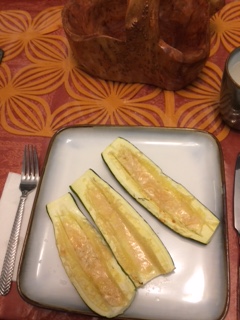
Dinner in photo above:
Organic zucchini stuffed with gran padano shredded cheese

Scoop out inside of zucchini. Sprinkle with parmesan or goat cheese.

Heat at 350 in oven for 25 to 30 minutes.

(I used gran padano because I didn’t have parmesan cheese.)

Night Snack:

1 organic Anjou pear

Meal Plan #1

salad october 2017

Sunday, October 8 2017

Breakfast:

Cheerio’s with organic skim milk.

Lunch:

Amy’s Organic Minestrone soup.

Afternoon snack:

7 mini sweet peppers from CSA box.

1 container Horizon organic chocolate milk.

Dinner:

CSA salad with green leaf lettuce, hot pepper slices, shredded red cabbage, tomatoes, and carrots. Newman’s Own balsamic salad dressing.

Night snack:

Fage 0 percent fat plain yogurt.

4 squares organic chocolate 74 percent cacao.

I’m not keen to buy cans of soup that have natural flavor as an ingredient.

Natural flavor is a euphemism for chemicals whose actual names don’t have to be listed on the nutrition label.

Yet make no mistake you’re consuming chemicals.

I’ll report back here with a recipe I’m making for some kind of squash that arrived in the CSA too.  It’s a Gold Nugget personal-size Hubbard. Perfect for lunch.

More recipes to come here in the coming weeks along with some belated fitness inspiration or what’s call fitspo.

Every little bit of wellness counts:

Just walking five blocks or have a salad or whatever bits and bursts and sprints of doing that we can helps us get mentally and physically better.

Every little bit counts.