Thinking About Recovery

Bari Tessler quotes Jack Kornfield in her book The Art of Money. A gem like this justifies buying her book. I installed in on my iPad.

This quote sums up a great way to think about recovery:

“The true task of spiritual life is not found in faraway places or unusual states of consciousness: it is here in the present. It asks of us a welcoming spirit to greet all that life presents to us with a wise, respectful, and kindly heart.”

Jack Kornfield

Thinking of recovery in this way is a way to take back our power over our circumstances. Our pain doesn’t have to last forever.

Our lives can be hard not because we have an illness–they can be hard simply because they’re not easy. This often has nothing to do with the illness.

I will go to my grave crediting my mother’s one quick action to get me the right help within 24 hours as the number-one reason I recovered. Today more than ever when a person gets the right help right away there can be an ed after the word recover.

Thinking about recovery as a process and a way of living our lives that we can honor precisely with a “wise, respectful, and kindly heart” is the way to go now if you ask me.

I’m skeptical when I see links in my Google Alerts for schizophrenia information when the tag line is “Rachel (or whoever it is) talks about what it’s like to have schizophrenia.”

That is totally misleading. The tag line should read: “Rachel talks about what it’s like FOR HER to have schizophrenia.”

It would be unhelpful and disingenuous for me to claim that my experience is the mirror of what everyone’s experience is like.

Instead I’m pulled to talk about my experiences as a springboard for showing readers that with their own kind of creativity and resourcefulness they can come up with their own path in their wellness journey.

That’s the contention that I make that is revolutionary: stating it thus: that recovery is a wellness journey. At least it has been for me and I think too that others can achieve their own version of well.

This is why I keep the blog: because for the last 12 years I’ve so strongly believed in my vision that people can recover and flourish and live life well and whole after they have a breakdown.

Your version of well is not going to be the same as mine and mine is not going to be the same as another person’s. That’s what’s beautiful about living here on earth: we’re like snowflakes – no two of us is totally alike.

We share things in common yes we do. Yet I’m always interested in the uniqueness of each person I meet or interact with. That is a precious gift: the gift of the spirit of a person that each of us was given when we were born.

I’ll end here by saying it’s high time to think about recovery as yes a spiritual practice as well as a lifestyle.

There’s no shame in living life in recovery.
The Art of Money

Bari Tessler has published a book to buy: The Art of Money: a Life-Changing Guide to Financial Happiness.

As an author Tessler has a generous and compassionate voice. As a Financial Therapist Tessler has revolutionized how to approach dealing with money matters.

On her website she talks about calling an emergency fund a Peace of Mind fund instead. In her book she tells readers to rename expense categories in our budgets to reflect our values. For instance Mortgage becomes Home Sweet Home.

Tessler’s vision is brilliant. Her insight and information is right-on. I recommend buying this Tessler book and the Vitug book I reviewed too–You Only Live Once. These two books taken together could be the start of creating a solid foundation with our finances.

You can go on the Bari Tessler website to read more.

In the late summer and into and through the fall I’m going to talk here again about career and job strategies. By the fall I’ll have more news about my second recovery book.

Sources of Protein

I found these sources of protein on a bodybuilding website:

Swiss cheese:

8 gm per 1 oz serving

Greek yogurt:

23 gm per 8 oz 0 fat plain

Sockeye salmon:

23 gm per 3 oz serving

Eggs:

6 gm – 1 large egg

Chicken breast:

24 gm – boneless skinless – per 3 oz

Turkey breast:

24 gm per 3 oz

Milk:

8 gm per 1 cup

Peanut butter:

8 gm per 2 tbsp

Quinoia:

8 gm per 1 cup

Tofu:

12 gm per 3 oz

Green peas:

7 gm per 1 cup

Tilapia:

21 gm per 3 oz

Light tuna canned:

22 gm per 3 oz

Shrimp:
11.6 gm per 3 oz


Sources of Fiber

Fiber is thought to fill a person up thus regulating appetite.

I’ve Googled sources of fiber and amounts. Buy a 2-cup measuring cup and you can measure the amount of food you’re cooking or using.

Lentils:

15.6 gm per cup cooked

Black beans:

15 gm per cup cooked

Peas:

8.8 gm per cup cooked

Broccoli:

5.1 gm per cup boiled

Brussels sprouts:

4.1 gm per cup boiled

Pear:

5.5 gm per medium fruit raw

Raspberries:

8 gm per cup raw

Blackberries:

7.6 gm per cup raw

Avocados:

6.7 gm per half raw

Whole-wheat pasta:

6.3 gm per cup cooked

Taken from Greatist website.

The Greatist website appears to be legitimate. It evens features kettle bell exercises you can do and body weight exercises you can do.

I’ll be back next week with sources of protein.

RDA of Fiber Protein and Water

You can figure out the RDA of fiber protein and water you need to consume at the USDA Healthcare Professional Quiz.

I stumbled on this quiz last week and I do not know how the USDA arrived at these numbers to give professionals. You can take the quiz even though you’re not a professional.

The thing is I’m skeptical of the results. The USDA is known to often be headed by industry folk not non-biased government officials. I’ve read in the book Uncertain Peril about the danger of industrial agriculture that the heads of Monsanto and other companies routinely go in and out of heading the USDA.

My RDA count is as follows from the above quiz:

21 gm fiber     40 gm protein     11 cups water / per day

I’m skeptical because in the 1990s the M.D. I saw who had a private practice in nutrition told me to have 50 gm of protein / per day.

The Harvard Protein RDA guide is here. Multiple your weight in pounds by 0.36. That gives me 43 gm protein.

From what I’ve also read within the last two years you’re supposed to divide your weight in half to get the number of gm of protein each day. And you’re also supposed to do this for the number of cups of water each day.

Here’s the Mayo Clinic Guide Water RDA.

Here’s the Mayo Clinic Fiber RDA:

Age 50 or younger:                    Age 51 or older:

Men: 38 gm                                  30 gm

Women: 25 gm                            21 gm

As you can see there’s different RDAs depending on which calculator and which “expert” opinion you believe. You can’t trust those diet books that people who are not professionals write. The last I counted at a public library in the diet section [613.25] there were a total of 30 diet books on the shelves. Thirty diet books!

I didn’t ever go on a diet when I wanted to lose weight. I read books on nutrition and changed how I ate one food at a time. I have also always done some form of exercise since I was a freshman in high school.

In my estimation the resources and sources I’ve listed above do seem like reputable guides to the RDA for fiber protein and water. The USDA guide for my fiber RDA was in line with the Mayo Clinic guide.

This should all reassure us that we don’t have to consume tons and tons of fiber protein and water just a realistic amount linked to our weight in pounds and other individual factors.

In coming blog entries I’m going to list types of common food and the gm of fiber and protein they have.

Indeed we can all can having orange juice not only because of its sugar. An actual orange as opposed to orange juice has 3 gm fiber for a medium orange. Orange juice of course does not have any fiber.


Organic Zucchini Recipe

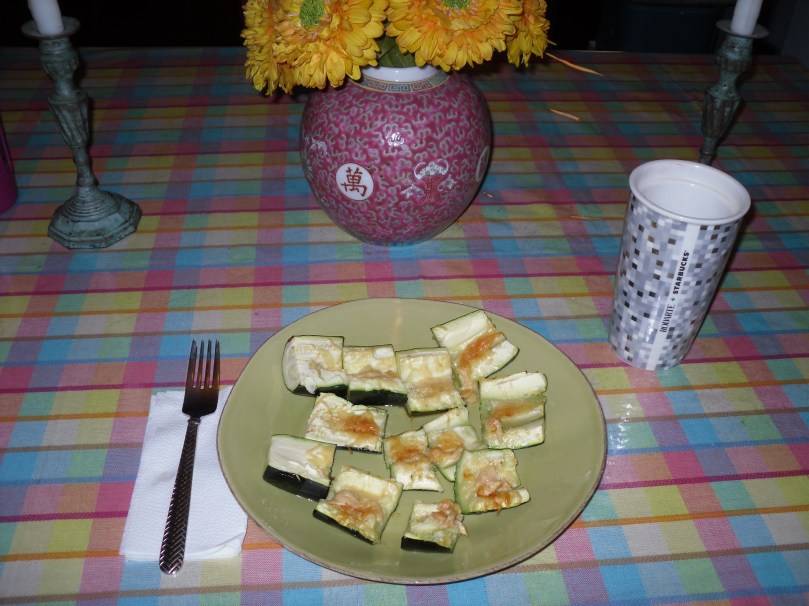
SDC10453

This organic zucchini recipe is quite simple: cut zucchini in half and hollow out center and fill with grated parmesan cheese.

Heat in oven for 350 degrees for 30 minutes.

Voila–a healthful summertime and early fall meal or dinner.

The ceramic Starbucks Venti cup is a Rodarte limited edition design. Rodarte is a fashion house. The cups were available about five years ago.

You can buy some nice ceramic cups in Starbucks. That coffee shop has some OK bistro food selections.
I will return with other recipes in the coming weeks. As always, you can click on the recipes category to the right or on the bottom of this page if you’re on a cell phone. I’ve posted a number of other recipes that are in season now.

Happy Eating!


Summertime

It’s summer.

I’m revising and editing and adding to my second book on recovery. I hope to publish it within two years with a traditional publisher. It fills a need in the marketplace.

I’ll be able to give more details about the book in the fall. Right now I’m keeping it under wraps except to say the book has a passionate and professional voice. That’s how it differs from a clinical treatise that an M.D. would write.

In this season I’m going to research healthier food options and talk about them here.

I like the Amy’s Organic soups and Pacific Organic soups. I have soup year round for lunch and for dinner with a salad or vegetable or fish.

The Earthbound Farms organic spring mix salad greens container is not that expensive so it makes sense to buy this product instead of regular iceberg lettuce.

What we put in our heads–positive or negative–effects our mental health. What we consume in our mouths affects our health and in so doing this it effects our mental health too.

May through November is Greenmarket season so that gives a lot of us seven months of healthful food options to buy and to prepare.

I shop at local Greenmarkets because of the “No Pesticides” signs above the produce on the stands.

In coming weeks I’ll post more photos of meals with recipes.

More towards September I should have news about the second book.

The Top 10 Fitness Motivation Tips

Set a SMART goal: one that is specific, measurable, achievable, relevant, and time-sensitive.

Be realistic yet challenge yourself. Research shows that setting easy goals makes us less motivated to try to achieve them. A challenging goal can be achievable when it’s a personally meaningful goal that we’ve set for ourselves not one that others have told us we should embark on. To achieve a goal we must be invested in it.

Focus on what you did do not on what you didn’t do.

Setting up impossible demands on yourself will set you up to fail. Be proud you exercised twice in one week instead of beating yourself up for not exercising five times.

Change one behavior at a time.

In the 1990s I started my inchoate quest to have better health. The first week I replaced whole milk with skim milk. Next I cooked chicken without the skin. Then I stopped cooking meat. And so on.

Reward yourself often for little victories as well as milestones.

My favorite is to shop at Banana Republic with coupon codes. The cost of the treat should be commensurate with the goal. I’m not advocating for spending a lot of money on rewards just on the kind of reward that boosts a person up.

Set performance goals as you go farther along.

Achieving perfect form, lifting higher weights, doing more reps or mastering an exercise you previously weren’t good at all count as possible performance goals.

Find the kind of exercise that is best for you.

I’m a big fan of strength training most of all for everyone as we get older and want to maintain a healthy weight and have functional fitness throughout our lives.

For you, your own Tour de Fitness might be taking spinning classes.

Focus on the positive long-term consequences of developing a consistent fitness routine instead of dwelling on the occasional setbacks that are often only temporary.

If for a week or two you haven’t exercised as often as you wanted or have “fallen down” in a way that upsets you be kinder to yourself and remember that “fitness is forever” and you’re not perfect. Aim for progress instead.

Remember that nutrition is 80 percent of fitness.

Food habits go hand-in-hand with exercise habits. Endless snacking and unhealthful eating can torpedo your efforts at the gym.

Re-frame your perception of “exercise.”

In my own life I use the umbrella term fitness not exercise. Fitness is an organic approach that encompasses lifestyle (thoughts and feelings, spirituality, finances, career and relationships, among other things).

Have fun.


Quick Asparagus Recipe

asparagus

I don’t feel like it violates copyright to offer you this asparagus recipe because it’s quite simple.

Roasted Asparagus with Olive Oil and Salt

1 1/2 lb asparagus tough ends snapped off

2 tablespoons extra-virgin olive oil

Salt

  1. Preheat oven to 450 degrees.
  2. Place asparagus in large baking sheet. Drizzle olive oil over the spears and toss gently to coat from end to end. Place the spears in a single layer.
  3. Roast in the oven until the asparagus are lightly browned, 12 to 15 minutes. Shake the pan once or twice within that time to turn the spears.
  4. Transfer asparagus to a serving platter and sprinkle with salt.

This meal can be served hot, warm or at room temperature.

I used only 1 lb asparagus so reduced the amount of olive oil I used.

I heated the asparagus in a glass baking dish. You can get a glass baking dish on the cheap in a dollar store. They can be bought at a dollar store in various sizes.

Again: the scallops take only at most 10 minutes to saute in a pan and are a good source of Omega-3 fatty acid.

Total time for this late spring healthful dinner: 15 minutes to cook.


The Champion’s Comeback

I’ve finished reading The Champion’s  Comeback: How Great Athletes Recover, Reflect, and Reignite by Jim Afremow. He also wrote The Champion’s Mind: How Great Athletes Think, Train, and Thrive.

Buy these two books along with Fight Your Fear and Win by Don Greene. The three books are the winners in terms of self-help. The Champion books can be used to excel at the game of life as well as on the playing field in sports.

From The Champion’s Comeback: “Ask yourself, ‘What are my big-picture goals–not just in sports and fitness, but in life?’ Then establish some daily, seasonal, and career goals that are challenging and reachable.”

You can install the two Champion books on an iPad or a Kindle.

Afremow tells it like it is: instead of trying to lighten our load we should seek to have broader shoulders.

Life isn’t easy yet as long as we try our best there can be no shame if we fail. If we didn’t give it our best shot we have to accept the outcome.

The Michael Jordan quote on the top right side of this blog is so true.

I know something readers:

Like Freddie Mercury sang in Queen:

We are the champions.

Buy these books and you won’t be disappointed.

Their tactics apply to life as well as sports.