2017 Blog Topics

Each of us needs to be able to advocate for ourselves.

We need to dialogue with our treatment providers and to research, research, research our options.

In January I’d like to talk about goal-setting in here: the effective antidote to making New Year’s resolutions that don’t stick.

Setting treatment goals and setting life goals is something under our control.

It makes sense that we’re the only ones who at the end of the day have command over the goals we set.Our family our shrink and our therapist can and should be our most integral allies in helping us achieve our goals.

As peers too we should all be cheering each other on.

We should be happy when one of us is successful and sad when one of us has a setback. Yet either way the goal is to offer feedback and encouragement and–always–hope.

What zings you as something you’d truly passionately want to do and to achieve in 2017?

I recommend that all the ladies out there  buy the Michelle Phan book Makeup: Your Life Guide to Beauty, Style, and Success Online and Off.

Her book is written in an inspiring and down-to-earth voice. She’s still younger yet I’ve enjoyed reading her book.

I’m going to quote Michelle Phan so that hopefully you’ll go out and get the book:

“I didn’t want a safety net under me. I wanted to force myself to make this work.”

Working longer and harder to achieve a goal is often necessary for those of us living in recovery. Yet giving up or not even trying to begin with isn’t the answer.

We can give each other the hope that with courage, strength, and confidence we’ll be able to have our own version of a full and robust life.

For some of us that’s going to be going grocery shopping instead of going to McDonald’s. For others it’s going to be applying to college and taking one or two courses a semester.

Stay tuned for blog entries on goal-setting in January.
Confidence: Getting It and Using It

The InStyle December issue features an interview with Cate Blanchett the Oscar-Award winning actress in its I Am That Girl column:

“How do you define confidence?

I think confidence is the acknowledgment of doubt. Fear is a natural state. You can’t truly achieve a creative life without it.” – Amy Synnott

It’s true that fear is part of being creative like Blanchett says. You can only achieve great things if you risk becoming uncomfortable when you do new things.

Failure is the cost of taking risks. Not everything you try to do will work out. I bombed out big time in the gray flannel insurance field.

Fear should be welcomed–not paranoia–the kind of fear where you’re not certain you’ll succeed but you have to try because the goal is too important to you to not risk trying.

All of us should be terrified to do something that has the potential to give us a better life.

Giving ourselves a challenge is the ultimate confidence-booster.

There’s no safety in playing it safe. There’s no triumph in conformity if you ask me. Sometimes you have to go out on a limb to see how far you can go.

Shakespeare wrote: “Cowards die many a time before their death. The valiant only taste of death but once.”

That’s not how I want to live: as a spectator in my own life.

Cate Blanchett is right: acknowledging doubt is the first step in taking a risk.

The more action you take, the easier it is to keep taking action. Taking action can cure fear.

I’ll end here with this: self-confidence is a natural high.

There’s no shame in acting confident and going after what you want in life.

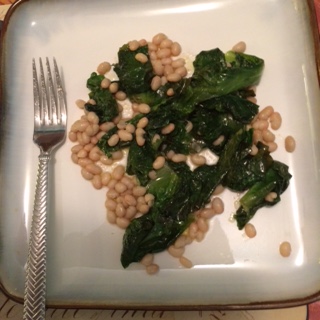
Cannellini and Escarole

white-beans-escarole

This recipe is quick and easy and healthful:

Buy a head of escarole and a can of cannellini and a head of garlic.

Rinse escarole thoroughly in water to remove any residual dirt and dry with a paper towel.

Cut leaves off and saute in olive oil for about five minutes until the greens are soft and not fried. Add chopped garlic. (You can use garlic powder if you don’t have fresh.)

Halfway through sauteing add the cannellini and cook.

I’ve used habichuelos here which are the tiny version of cannellini.

Voila–in under ten minutes you can cook a dinner for one.

Add a stick of string cheese for a complete protein.


Telling Our Stories

At the educational conference I was the first person to talk at the session on: The Impact of SSI and SSDI on Going to Work.

My co-presenter detailed how to apply for these benefits and how to use the Ticket to Work and PASS Plan options to find a job so you can stop collecting SSI and SSDI.

At the start of my talk I quoted lines from the Anne Sexton poem “For John, Who Begs Me Not to Enquire Further.”

She is a famous poet who had her own mental health challenges and is no longer here. Sadly, like a lot of gifted artists, she took her own life.

Yet the lines from her poem are often quoted. She tells the reader that she has nothing else to give and that what she has to give can be hopeful in its own way.

After I quoted the lines I told the audience: “This is my story. It’s the only story I have to tell. It’s unusual and a little atypical. I tell it to uplift and inspire others.”

I’m here to say that what you feel can be healed. Pain can end. I’m a firm believer in using our pain as the catalyst for self-growth and finding out what our life’s purpose is.

I stand by the motto: “service above self.”

It’s true that you get what you give–plain and simple–you get what you give.

Other forums exist in which to spread hate of psychiatry, hate of people who are different from you, and any other kind of hate.

This blog will always be not just a hate-free zone it will be a healthy zone.

It comes down to this: my ethic is: “This is my story–it’s on the table. You can take it or you can leave it.”

In the next blog entry I’ll talk about the new dynamic of holding a job circa 2016.

Risking Failure to Succeed

A little-known fact:

I was on the debate team in high school. I had to write a speech and memorize and present it as part of a team of students who traveled on Saturdays to other schools to compete.

Yes, I gave the speech from memory without looking at notes.

The students were ranked from 1 to 5–5 people the lowest–and the students with the most #1s took home the trophy.

I wasn’t an honors student at the time–I was in the regular classes. Yet I had gotten the ideas when I was a freshman in high school that public speaking was an important skill to have.

Readers, I routinely scored at a 4 or 5. That’s how I know that you can succeed at something even though you failed big time in the past.

As a junior in high school I got a job as a cashier in a supermarket using an old-fashioned cash register. I was fired five days later because I wasn’t any good at it. In college I had the chutzpah to apply for a job as a cashier in a supermarket again.

This time I succeeded.

I write about this because failure is often the cost of doing business in the real world. I write about this because it’s a reminder that for a lot of us success won’t come easy.

Giving up isn’t the answer. Seeing how we can do things differently or do different things so that we can succeed can be a better option.

The solution is to keep risking trying to do things.

Right now I’m writing fiction–my first novel. I have no idea whether it’s any good yet I want to perfect it so that I can start to publish fiction too.

I write about failure because often just starting out in recovery it isn’t going to be easy taking the risks to do the things you want to do.

Most of all, I wanted to be a cheerleader because I didn’t have a lot of cheerleaders when I was involved in the community mental health system.

There’s no shame in wanting to have a better life. There’s no shame in wanting to do better for yourself.

I cannot and will not be complicit in reinforcing that people with mental health conditions are helpless and that our future is hopeless.

So I dare readers: set a goal. Take a risk.

Believe in tomorrow because the future can be better.

Embracing Failure to Grow as a Person

The quote on the upper right side of this blog I stole from a silver paperweight I bought in a museum gift shop. The paperweight has this Michaal Jordan quote on it.

That should tell you something right there about the validity of the quote when you know a champion athlete with great success in life is the person quoted.

“Don’t Be Afraid to Fail. Be Afraid Not to Try.”

At HealthCentral when I was the Health Guide there for close to nine years the editorial team wrote a news article that must have stole something I wrote elsewhere on that website.

The editorial team had the boldness to write in the news article that: “The only real failure is the failure to try.”

And they understood that for those of us with an MH challenge sometimes trying can be as simple as getting out of bed or taking a shower.

My take on this is that as long as we try our best there can be no shame in failing. Giving our goals our best shot counts more than whether we actually achieve what we set out to do. I bombed out big time in my first career in the gray flannel insurance field.

Failure is simply the cost of doing business in the real world.

Experiencing failure is necessary to grow as a person.

When you’ve lost your mind there is nothing else you could ever fear losing.

Thus people with MH challenges have nothing left to lose and everything to gain by risking achieving goals.


We need to fail to learn what not to do.

We need to fail to experience all that life has to offer.

We need to fail in order to succeed later.

Like Michael Jordan I too was always afraid not to try.

The alternative–not risking getting a job–was no option.

I didn’t want to be doomed to collecting SSI forever and living in a dangerous crack-drug-infested apartment complex on the edge of town the rest of my life.

In recovery as in life there are no guarantees.

Yet if we don’t take these kinds of speculative risks that involve the possibility of failure (the possibility of gain or no gain):

There’s only one guaranteed outcome:

No chance of potential success either.

My motivation for taking the risk to get a full-time job in 1990 was simple:

I sure didn’t like living in an apartment where my friend and I joked that we had cockroach races to see which bug got to the other side of the living room first : )

I’ll talk more in coming blog entries about taking healthy risks.

September 11, 2001 – 15th Anniversary

Every year on September 11th I write a blog entry about the World Trade Center attacks.

A guy I love more than life itself was a first responder.

He was a New York City firefighter who rushed into those burning buildings to save people.

This guy and others who lived now have PTSD because of their involvement.

I’ve written in this blog recently about trauma.

In effect a person can have PTSD even if they haven’t served in a war.

Any traumatic event can bring on an ongoing hard time after it happens.

Each of us living on earth needs to “get with the program” as the expression goes.

Hate, violence, killing, racism, and any other kind of bigotry or senseless judging has to STOP.

I abandoned organized religion for good after September 11, 2001.

Being told that it’s OK to kill in the name of God–that it’s OK to hate and judge in the name of God–that’s it’s OK to view a woman’s role in life solely as a breeder–is NOT right.

I’m not attracted to women romantically. I’ve only ever had the hots for guys. Yet when the Supreme Court legalized marriage for every couple living in America regardless of sexual preference I only cheered this and was proud to be American.

I don’t have the inclination, temperament, or desire to sit around judging people.

I do align as a Christian though I’m no fan of organized religion.

God gave everyone living on earth this time around a divine purpose for being here.

Finding out your life’s purpose and going and doing that will make all the difference in having a healthy, happy, and prosperous recovery.

My purpose is not to judge anyone else. My purpose is not to tell people what they should do.

My goal is to use my experience living in recovery to help uplift and inspire others to dream of having a better life.

Today more than ever having a full and robust life is possible.

Won’t you join me in stomping out the hate and stigma?

Recovery and Pride

I know plenty of security guards who have college degrees. I met a janitor who loved his work and had a big grin on his face when he told me he was a “custodial engineer.”

No kidding. Any honest job labored at with pride can give a person dignity.

You will not always like every aspect of your job every day. Yet finding a job where most of what you do is okay is possible if you ask me.

I’ve worked in offices and libraries and a law firm. I’ve been employed for over 25 years.

Starting in the fall I’d like to return to talking about employment.

First here I will take about each aspect of The Triangle of Mental Health: appropriate medication, quicker individualized treatment, and practical career counseling.

Trusting Our Intuition

I watched a Suze Orman DVD a couple of years ago.

One guy she singled out had gone to school to get a degree so he could have a better career. He couldn’t find a job and might have incurred student loan debt.

He had been a waiter. Suze Orman berated him. She told him he could’ve had a perfectly fine life if he continued to wait tables.

After she was done trussing him up it looked like the guy was about to cry. His eyes were wet. She had publicly humiliated him.

Frankly, that’s not how I want an “expert” to treat me.

I’m confident we’ve all felt guilty and ashamed when we’ve tried to live by an expert’s rules and failed.

The kicker is: I went back to school when I was unemployed so that I could get a degree that would enable me to have a better career.

Suze Orman is against people doing what I did: going back to school instead of immediately looking for a replacement job.

Yes: I do think we need to trust our intuition more.

We need to pay attention to how our bodies feel and what our bodies are telling us.

Plenty of peers get college degrees. Not everyone uses their degree on the job they have. Yet educating yourself is not ever a waste of time or money if you ask me.

I’ll talk about this in future blog entries: why I think and will always think it’s no crime to want to do what you love and earn a livable wage or salary from it.

Telling a person that he should be content to wait tables when that is not what his soul calls out for him to do is a mistake.

Better: tell him that if he can’t find another job he can wait tables and do something else on the side that brings him more happiness.

Using our intuition to decide what’s the right thing to do makes sense.

Maybe the waiter convinced himself to purse the career-of-the-moment instead of listening to what the still voice inside him told him he was passionate about.

Maybe he could’ve done volunteer work in the new field to put on his resume when he did start to look for a new job.

Maybe he realized in the end that it wasn’t where his heart was after all.

In my blog I’ll talk about what I think is practical to do and what is possible to achieve.

My goal is to be a cheerleader not a naysayer.

You can decide for yourself if what I write makes sense.

I don’t think shaming people or making them feel guilty is pretty.

Getting Real Help

I had a job as the Health Guide for HealthCentral’s schizophrenia website for nine years.

What I wrote for HealthCentral was in the vanguard of mental health reporting. What I wrote was always five years ahead of what other people and organizations were writing about recovery.

Years ago at HealthCentral I would write a series called Family Members Forum. In one of those news article I gave ideas as to how to help a loved one.

Point blank I wrote this: “Ask your loved one: “What do you need me to do right now to help you?”

In this way everyone in society needs to “get with the program” as the expression goes in how they interact with people living with and impacted by a mental illness.

I always wanted people to see me not my pain. Jodi Picoult is quoted: “People are more than the sum total of their disability.”

The producer Mark. R. Weber understands that maybe we can’t end homelessness and we can’t always give a homeless person money. Yet we can stop for a moment to talk to them to ask their name and show we care about them as a human being.

In this way too people need to start breaking bread with those of us who have some kind of mental health challenge. It’s a Catch-22 because a lot of us don’t go around telling people “Hi, I’m so-and-so and I was diagnosed with ______________.”

So a lot of times no one else knows what we’re going through unless we tell them.

What is the solution? Brene Brown wrote about this in her classic book Daring Greatly. We should tell only the people who have earned our trust.

I understand what it’s like to not trust mental health providers.

I had to quite seeing a doctor immediately because of his unprofessional behavior. This is revealed in a humorous scene in my memoir. I fled his office one night and didn’t ever return.

This lack of trust has extended to mental health service providers like state employment agencies for individuals with disabilities.

For at least five years now I’ve realized there was a need in the marketplace for my second book–a one-of-its-kind self-help book.

In September I will start to talk about this book and about a new business I hope to provide to peers linked to this pressing need that has historically gone unfilled.

I ask you: when has any other person asked you: “What would YOU like to do with your life and how can I help you do that?” Instead of telling us: “This is what you should do and there’s no other option only the one I deem appropriate.”

VESID in New York City would send people who were deaf to a printmaking program long after jobs in that field became obsolete. Peers were disillusioned with this state employment services agency for years.

There’s a better way. In this regard I want to start my own peer-owned business to fill this need that has gone unmet. Stay tuned in September for more news about this.