The Top 10 Fitness Motivation Tips

Set a SMART goal: one that is specific, measurable, achievable, relevant, and time-sensitive.

Be realistic yet challenge yourself. Research shows that setting easy goals makes us less motivated to try to achieve them. A challenging goal can be achievable when it’s a personally meaningful goal that we’ve set for ourselves not one that others have told us we should embark on. To achieve a goal we must be invested in it.

Focus on what you did do not on what you didn’t do.

Setting up impossible demands on yourself will set you up to fail. Be proud you exercised twice in one week instead of beating yourself up for not exercising five times.

Change one behavior at a time.

In the 1990s I started my inchoate quest to have better health. The first week I replaced whole milk with skim milk. Next I cooked chicken without the skin. Then I stopped cooking meat. And so on.

Reward yourself often for little victories as well as milestones.

My favorite is to shop at Banana Republic with coupon codes. The cost of the treat should be commensurate with the goal. I’m not advocating for spending a lot of money on rewards just on the kind of reward that boosts a person up.

Set performance goals as you go farther along.

Achieving perfect form, lifting higher weights, doing more reps or mastering an exercise you previously weren’t good at all count as possible performance goals.

Find the kind of exercise that is best for you.

I’m a big fan of strength training most of all for everyone as we get older and want to maintain a healthy weight and have functional fitness throughout our lives.

For you, your own Tour de Fitness might be taking spinning classes.

Focus on the positive long-term consequences of developing a consistent fitness routine instead of dwelling on the occasional setbacks that are often only temporary.

If for a week or two you haven’t exercised as often as you wanted or have “fallen down” in a way that upsets you be kinder to yourself and remember that “fitness is forever” and you’re not perfect. Aim for progress instead.

Remember that nutrition is 80 percent of fitness.

Food habits go hand-in-hand with exercise habits. Endless snacking and unhealthful eating can torpedo your efforts at the gym.

Re-frame your perception of “exercise.”

In my own life I use the umbrella term fitness not exercise. Fitness is an organic approach that encompasses lifestyle (thoughts and feelings, spirituality, finances, career and relationships, among other things).

Have fun.


The Top 100 Fitness Foods

SDC10449

The Top 100 Fitness Foods is featured in this photo. If I remember the book costs under $20. It lists peanuts as being high in protein along with almonds and walnuts. Walnuts are a great plant source of Omega-3 fatty acids.

The green leaf lettuce came from the CSA box so as you can see you can get multiple servings from one box of organic produce.

The organic lime-pepper vegetable tofu soup is the Splendid Spoon offering.

I read in Self magazine about the woman who founded Splendid Spoon. I also like their lentil-kale soup. I didn’t like her cauliflower-coconut soup though.

Each 16 oz container of Splendid Spoon soup costs $6. You can spend close to $4 on Progresso soups which have chemicals. So springing for the extra dollar or two for Splendid Spoon offerings makes sense to me. The soup is organic and fills you up.

I had written in here about research that indicates poor nutrition can lead to depression.

From The Top 100 Fitness Foods:

Under beans and legumes section:

Lentils –

“Lentils are also crammed full of folate, an energy-boosting vitamin that plays a key role in the production of serotonin, the neurotransmitter in the brain associated with feeling happy.”

Food to improve mood: what better way to enjoy the day?

I recommend everyone buy a copy of The Top 100 Fitness Foods.

As you can see in the photo, it’s a short, compact volume. The book also features recipes and a food and ailments directory in the back.

Organic Versus GMO – The Real Deal

We need to have a sane conversation about the real deal when it comes to organic versus GMO.

The number-one reason GMO crops should be verboten is because they require killer amounts of pesticides to be grown. In this way industrial agriculture is not sane.

Products should be labeled if they contain GMOs simply because people want to know.

Yet the current backlash against GMOS has resulted in clever food marketing by companies that advertise their products as non-GMO. This is false advertising because “USDA Organic”-labeled products are legally allowed to have 5 percent non-organic ingredients.

Reading their ingredients label you’ll see they use “natural flavor”– a chemical legally lurking in food even though it’s not natural at all–it’s a chemical.

So Curate Snacks is the latest ploy of so-called “Non-GMO” products billing itself as having “no artificial flavors.” That’s technically valid yet if you go on their website and read the nutrition facts they list “natural flavor.” A natural flavor is not ever Non-GMO.

This is all USDA-approved “smoke-and-mirrors” so that big business can get away with using chemicals without listing their chemical names.

The solution is to eat mostly 80 percent or higher food that comes from God’s green Earth.

Any kind of power bar like Kind, Luna, Clif, Skinny Girl, and now Curate are not organic.

In fact, the Non-GMO label is being slapped on any products to suggest they are–when the bottom line is: we all could do better by eating whole food–that is real food not chemical-laden garbage.

I do eat food that comes from GMO crops on occasion. I shop at Greenmarkets because of their “No Pesticides” signs for the produce. “No Pesticides” is the real deal in how crops should be grown.

Locally harvested food is the real deal–not crops transported thousands of miles across the U.S.via gasoline-guzzling trucks.

Fair trade sticker food is the real deal too. Sharing a meal you cooked with others is the real deal.

This is the last time I’m going to write about natural flavors. The topic is finito. I don’t want to keep throwing this spaghetti against the wall to see if it sticks.

I’ll end here with this compelling evidence:

Eubie Blake was quoted at 90: “If I knew I’d live this long I’d have taken better care of myself.”

Exercise May Reduce Cancer Risk

A research study indicates that exercise may reduce the risk of 13 cancers.

Maintaining a healthy lifestyle could decrease cancer deaths by 67 percent for men and 59 percent for woman.

A healthy lifestyle could lower the discovery of new cancers by 41 percent in women and 63 percent in men.

As defined a healthy lifestyle is one where a person doesn’t smoke, doesn’t drink too much, maintains a body mass index between 18.5 and 27.5, and exercises 75 to 150 minutes weekly.

Seventy-five minutes of vigorous exercise or 150 minutes of moderate exercise counts in this number.

I strength train two or three days a week for the most part. It adds up to between 80 minutes and 150 minutes.

Today I received a CSA box–a box of community-supported agriculture produce items from a local farm. The produce I bought is organic. There’s enough in the box to create three or four “vegetable” sides for three or four meals.

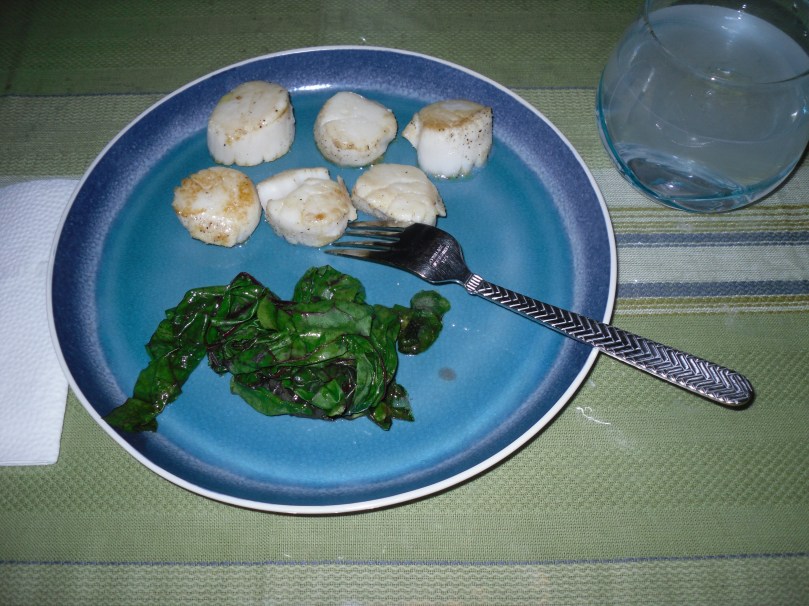
The photo below shows one dinner with local dry sea scallops and red chard. You can simply heat up olive oil in a saute pan and cook the red chard until it’s wilted yet not too dark. The sea scallops can be cooked for five minutes on each side with a little salt and pepper and garlic powder.

Here’s a nutrition fact you might not know: scallops are a good source of Omega-3 fatty acids. And the red chard–well greens in any form are always good.

This dinner is quick and easy: it takes only 10 minutes total to cook the items.

scallops red chard


Pantry Staples

In the book What the Fork? Stefanie Sacks lists common food items and where and for how long you can store them. In Real Simple magazine a number of years ago it featured this kind of cheat sheet in a more detailed fashion.

This got me to thinking what kind of contemporary healthy kitchen a person could stock to make it convenient to eat more nutritious food. Ideally, on nights when you’re too tired to cook there should be better alternatives to some kind of soggy sugary flakes cereal.

Indeed: it’s been years since I’ve resorted to having cereal for dinner. You can click on the recipes category to find simple to prepare meals that can stand in for that ubiquitous cereal-for-dinner lassitude.

See if having on hand these staples would make it easier to cook more healthfully and also when we’re low on money:

Refrigerator:

Eggs – 1 month.

Butter – will last 3 months unopened and 2 weeks opened.

Sesame oil – will last 6 months

Maple syrup – will last 1 year opened.

Mustard – will last 1 year opened.

Deli olives  – will last 2 weeks.

Broth – will last 4 days.

Salad dressing – will last 1 month.

Pasta sauce  will last 4 days opened.

Pantry:

Honey – will last 1 year opened or unopened.

Hot sauce – will last 2 years.

Onions and garlic – will last 2 months.

Canned beans – will last 9 months.

Pasta – dried – will last 2 years.

Olives – jarred – will last 6 months unopened.

Pasta sauce – will last 9 months unopened.

Vinegar – will last 1 year opened – 2 years unopened.

Olive oil – will last 6 months opened – 1 year unopened.

(All other oils should be stored in the refrigerator. They can keep in a cool fridge for 1 year.)

Salad dressing – 1 year unopened.

This is good news because if you stock a pantry with these items you can buy salad greens and then use the olives and salad dressing and chick peas or other beans in the pantry to create a salad.

You can also use the eggs to create my Baked Eggs in Tomatoes recipe. (In season in the summer or out of season at other times.)

I’m not going to judge a person who eats meat. I’m not going to judge a vegan either. Each of us has to do what makes sense for us. A lot of the information I’ll be writing about was gleaned from What the Fork? by Stefanie Sacks.

I’m not going to say “read it and heed it” for anything I write or what I refer to from a book. I’m simply like a librarian giving information.

You can see if it makes sense.

I write about fitness and nutrition now because it’s high time someone living in recovery came out and wrote in specific detail about these things.


3-Point Guide to Mood-Boosting Food

I have developed a 3-point list of what I think makes sense when choosing what food to eat:

Eat well–you’ll feel better.

East mostly food that comes from God’s green Earth.

The best stuff on earth truly comes from Earth.

Not a bottle or frozen box. Pass on chemical-laden drinks and foods with unnatural “natural flavors.”

Nix sugar.

Remember: sugar is sugar wherever it comes from. Refrain from drinking chocolate milk–it has 33 grams of sugar in an 8 oz glass. Not good if you take an atypical medication for schizophrenia or bipolar that can increase the risk of getting diabetes.

Bonus point:

If memory serves it was Michael Pollan who wrote: “Eat food. Not too much. Mostly plants.”

A friend is now going on an eating plan geared to a person with diabetes even though he doesn’t have diabetes. This could make sense as a possible plan for individuals with mental illnesses to adopt.

Lastly: I do NOT endorse drinking sugary sports drinks or Power-Ade type drinks. Not at all. Nor do I endorse drinking Red Bull or other type energy drinks. I DON’T endorse eating power bars of any kind except every so often in a crunch when you have nothing else available. And the shakes available at gyms aren’t the most healthful option either. I only have a shake once or twice a month.

The goal is to remember that when you eat light and healthful there’s almost no restriction so you’re not depriving yourself: you can then have a pastry every so often.

The 80 Percent Guide

Pamela Peeke, M.D. in her book Body for Life for Women talks about her Mind-Mouth-Muscle trifecta for obtaining optimal health through the four Milestone periods of our lives.

Her foolproof advice is to follow her eating plan 80 percent of the time. That’s right: you can eat healthful food 80 percent of the time and that’s perfectly okay according to Peeke.

I don’t follow her eating plan to the letter because you have to remember the right combinations of food to eat. If you photocopied the pages with the eating plan and committed to reviewing it every day so that you could choose from it: you might start to remember the plan without looking at the pages.

Stellar advice she gives is that eating too much of any food even healthful food is not good. If you eat better food and choose quality over quantity you will also save money because you’re not buying as much food.

I don’t eat a lot of food. I try to switch up: eat organic Fuji apples when they’re available, pears and raspberries and other fruit when it’s in season (because in-season fruit IS cheaper.)

Buying seasonal produce is cheaper so it makes sense to do this. Yet I buy organic bananas year-round and I do eat bananas.

The 80 percent guide makes sense to me. I can’t resist the macarons at a hole-in-the-wall coffee shop. Or every so often I will have a chocolate crepe. There you go.

Keeping a food log and writing down what you eat for two weeks is a great way to keep track of what you’re eating if you want to lose weight. The equation is simple: burn more calories than you consume.

Life isn’t always easy and doesn’t always go as planned. That’s when it makes sense to forgive ourselves and move on and recommit to healthful eating.

I want to quote an advertisement in Women’s Health magazine. Jillian Michaels the trainer is pushing Krave jerky in it. I don’t recommend eating any kind of jerky or beef or meat at all. If a person does only one thing, not eating meat would be the one thing to do.

While I don’t endorse any products at this time the advertisement is right-on about the reality of life. I didn’t read the rest of the advertisement because as soon as I saw the word jerky I didn’t think the product could be healthful.

Here’s the tag line:

“I’m going to do the best I can given what I have today. I’ll never settle.”

I’ll end here with those words. They’re so apt for what happens when our lives take a turn and we have to ride out a hard time:

“I’m going to do the best I can given what I have today. I’ll never settle.”

The Mediterranean Table

I want to return to talking about nutrition. I recommend buying or installing on your device The Mediterranean Table cookbook-and-nutrition guide.

Right now I consider it the best book of its kind ruling over any of the others I’ve reviewed. Angelo Acquista, M.D. shares detailed info about themost healthful foods in an engaging, simple, easy-to-read fashion.

Read only this Mediterranean Diet book if you read no other–it’s that good. I can’t help be proud–after all, I’m Italian.

Circa 1993 I bought and read the original Mediterranean Diet book. This so-called “diet”–actually a sane eating plan–has been around forever.

With this time-tested way of eating I ask you: why do most people go on any of the fad or extreme diets outlined in the endless glut of diet books at the library?

Have some filet of sole oreganata with a side of broccoli rabe. Keep the portions slim.

That’s the secret right there: you don’t need to eat meat and [white] potatoes.

You want to impress an Italian [or other] woman on a date: cook a simple meal of pasta with tomato-basil sauce and a salad of kale and cherry tomatoes with a squirt of olive oil and vinegar or olive oil and lemon.

Perfetto.

Love and Loss

Other things you can add to a salad are walnuts or almonds. I used to use chick peas in a salad too. You can used blue cheese like in a Cobb salad. Olives of course can go into a salad. Onions too.

We need to eat well to keep our energy up when we’re going through a hard time.  We need to continue a bare-bones yet consistent and regular fitness routine when we’re going through a hard time.

Life can be hard and present us with challenges. We can return to our full-steam activities when we’re able.

It can be hard most of all when our loved ones have a hardship or an illness that we have to cope with.

It is most of all the hardest when a loved one is at the end of their lives.

I’ve written in the blog and elsewhere that mental health agencies universally fail their older constituents who are now living alone after their parents / caregivers have died.

I wrote at HealthCentral for our family members about doing succession planning and creating a Special Needs Trust instead of a will for a loved one who collects SSI for the rest of their life.

Not ordinarily do I like to give details in the blog about my own life. I will though say this: no one should be faced with terminal cancer at the end of their life like one of my family members is now.

I will write in the future about grief and bereavement from information in the pamphlets I picked up at the 2014 APA convention.

For now I will end here with this thought: we could benefit each of us from reaching out for support when our family members are in their seventies and eighties and won’t be around for a lot longer.

I will do my tiny humble part by writing about grief and bereavement in the blog. Mental health agencies should no longer avoid talking about this. I’ll talk about this since they’re not.

Chockfull of Salad

I tend to have a lot of salads. You can buy Earthbound Farms organic kale on the cheap and it will last for four days of servings.

Here’s an easy simple recipe:

Cut kale or other greens up. Peel and chop carrots. Use olives. Cut tomatoes into wedges. Slice an onion. You can also slice bell peppers.

Toss into a salad bowl. Add olive oil and vinegar or olive oil and lemon. Squirt onto the salad to your taste and toss.

I add grated parmesan on the salad after I use the dressing on it.

Here’s a handy secret that I really shouldn’t be giving away:

You can buy pre-made salads and place them in individual salad bowls to serve to guests at a dinner party. You can find store-bought salad dressing to use that is a healthful option like Cucina Antica organic salad dressing

Fresh Direct is an online delivery service in New York City and Philadelphia. Peapod is available in a lot of other places online. Either way you get groceries and household supplies delivered right to your front door.

I buy Greek salads this way and found a Fresh Direct olive oil-and-sundried tomato vinaigrette dressing to use on the salads.

Bobbi Brown the famous makeup artist in her book Living Beauty describes how to make what she calls a “chopped kitchen salad.”

Whether it’s her version or mine I make the case for having more salads and other greens for lunch or dinner.

You can get a CSA box delivered from Fresh Direct–a community-supported agriculture box of 8 to 10 items of produce from June through end of December. It comes from a local organic farm.

The $30/box has enough produce to make a variety of meals or side dishes. I received butter leaf lettuce and created a salad for dinner one night along with a recipe for lemon-and-thyme carrots.

It’s true I’m obsessed with eating mostly only real food that comes from God’s green earth not a laboratory.

Get the cookbook Vegetables Every Day by Jack Bishop. I find myself running to this book every week to cook the produce I buy. The recipes are simple and easier to cook because they don’t often take up a lot of time.

Happy eating!