The Champion’s Comeback

I’ve finished reading The Champion’s  Comeback: How Great Athletes Recover, Reflect, and Reignite by Jim Afremow. He also wrote The Champion’s Mind: How Great Athletes Think, Train, and Thrive.

Buy these two books along with Fight Your Fear and Win by Don Greene. The three books are the winners in terms of self-help. The Champion books can be used to excel at the game of life as well as on the playing field in sports.

From The Champion’s Comeback: “Ask yourself, ‘What are my big-picture goals–not just in sports and fitness, but in life?’ Then establish some daily, seasonal, and career goals that are challenging and reachable.”

You can install the two Champion books on an iPad or a Kindle.

Afremow tells it like it is: instead of trying to lighten our load we should seek to have broader shoulders.

Life isn’t easy yet as long as we try our best there can be no shame if we fail. If we didn’t give it our best shot we have to accept the outcome.

The Michael Jordan quote on the top right side of this blog is so true.

I know something readers:

Like Freddie Mercury sang in Queen:

We are the champions.

Buy these books and you won’t be disappointed.

Their tactics apply to life as well as sports.

How to Be Successful

I know of no other way to be successful than to work longer and harder at a goal that resonates with you as life-changing.

I was 46 when I started to work out at the gym like a madwoman in training for the prizefight of her life. Before that I hadn’t lifted even 5 pounds.

If you have a life-changing goal that you want to make happen I find it helps to focus on this goal with a laser-precision.

A lot of things you decide you want to do might not work out in the long-term or you might abandon those goals along the way.

Yet a life-changing goal is one that should be pursued with all the energy and focus you can drum up for yourself.

I’ve been strength training for over 5 years now. I added two new exercises to each routine I do. The benefits accrue the longer you keep at a goal. I’m fitter than I was 5 years ago. The longer you continue to strength train the better your body will get.

Engaging in a fitness routine is one foolproof way to be successful in life. Our bodies are workhorses that can help us accomplish our goals.

I have always exercised in some way ever since I was a freshman in high school.

I could only do 5 sit-ups in one minute in gym class back then. My goal was to achieve the highest score: 50 sit-ups in one minute. I kept at it until I was able to do 50 sit-ups in one minute.

You could say that was the first meaningful goal I ever set.

Ever since then I’ve done some form of exercise throughout my life.

Now I strength train 2 to 3 days a week with cardio every so often.

I think it’s a myth that success is ever quick and easy. It’s a myth that you don’t have to exert effort to be successful. Nothing worth having comes without effort.

I’ll end here by saying that sticking with an exercise routine is what counts. Think long-term. If you slip up here and there just recommit.

I recommend the Jim Afremow book The Champion’s Comeback: How Great Athletes Recover, Reflect, and Reignite. His first great book was The Champion’s Mind: How Great Athletes Think, Train, and Thrive. I have his first book on my iPad and will buy the second one soon.

Forget the Kardashians. Stop thinking other people have it easier or have it better. Find realistic role models who can inspire you.

It’s going to take years and years sometimes to get to where you want to be. Keep up a positive spirit. For some of us success might come quicker. Yet when it doesn’t the secret is to not give up.

The bottom line: if you commit to strength training for 5 years and then continue on after that you can continue to see even better results. Giving up on exercising after only three months is not the way to go. Even if you only train or exercise two days a week for a certain period that’s better than quitting totally.

I was just an ordinary person. I had no guarantee that I would succeed. The difference was I trusted myself to take action in the direct of my goals.

Not everything I did worked out (hello – gray flannel insurance career). Not everything you decide you want to do will work out.

It’s the process of trying your best every day that counts – not the result.

Using Self-Empowering Language

not true

A friend and I talked over hot chocolate in a coffee shop. “Here.” T. reached into his wallet. “For you.”

“Thank you.” I accepted the black decal with white letters that read: This is not true—a slip like a fortune cookie.

“Joe Strummer gave these kinds of slips out. You like the Clash, right?”

“Sure do.” I thought the ticker would be a clever title for a blog: This is not true.

I’ve always had the idea to interview peers who’ve been through a hard time too—and post to my blog their talk about other things in their lives—without referring to illness or diagnosis at all.

This weekend I chose boldly not to use clinical terms—no diagnoses—going forward. First—those words scare people—and second it’s a trap. Identifying a person by their symptoms locks them into a no-win mental straitjacket.

Thomas Insel–the former director of NIMH–created the RDOC system to link research funding to clusters of symptoms not specific diagnostic categories like bipolar.

This inspires me now to take the bold leap into more positive language because in leaping the net will appear: a soft landing in recovery not on rocks and garbage. To be pelted with ignorance doesn’t have to be our fate.

So stand up and assert your rights. Tell others: “I’m a human being–treat me like one. You’re most likely not so hot yourself, so why do you think I’m less than zero?”

I’m going to continue to focus on today in the blog because today is the greatest day.

I’ll talk about health/salut and wealth/dinero and love/amore in ways that no one else is talking about these things.

Listen: what’s truly cray-cray is stereotyping everyone you meet because of your experience with one person or two or a few people with similar traits.

This is not true: that we’re so damaged by what happened to us that we can’t have a full and robust life.

This is not true: that we don’t deserve compassion and other people should cower in fear of us.

This is not true: that we’re so effed up that we’re beyond repair.

What is true: that how we live–what we do and say–has the power to make the world a better place.


The Top 100 Fitness Foods

SDC10449

The Top 100 Fitness Foods is featured in this photo. If I remember the book costs under $20. It lists peanuts as being high in protein along with almonds and walnuts. Walnuts are a great plant source of Omega-3 fatty acids.

The green leaf lettuce came from the CSA box so as you can see you can get multiple servings from one box of organic produce.

The organic lime-pepper vegetable tofu soup is the Splendid Spoon offering.

I read in Self magazine about the woman who founded Splendid Spoon. I also like their lentil-kale soup. I didn’t like her cauliflower-coconut soup though.

Each 16 oz container of Splendid Spoon soup costs $6. You can spend close to $4 on Progresso soups which have chemicals. So springing for the extra dollar or two for Splendid Spoon offerings makes sense to me. The soup is organic and fills you up.

I had written in here about research that indicates poor nutrition can lead to depression.

From The Top 100 Fitness Foods:

Under beans and legumes section:

Lentils –

“Lentils are also crammed full of folate, an energy-boosting vitamin that plays a key role in the production of serotonin, the neurotransmitter in the brain associated with feeling happy.”

Food to improve mood: what better way to enjoy the day?

I recommend everyone buy a copy of The Top 100 Fitness Foods.

As you can see in the photo, it’s a short, compact volume. The book also features recipes and a food and ailments directory in the back.

Organic Versus GMO – The Real Deal

We need to have a sane conversation about the real deal when it comes to organic versus GMO.

The number-one reason GMO crops should be verboten is because they require killer amounts of pesticides to be grown. In this way industrial agriculture is not sane.

Products should be labeled if they contain GMOs simply because people want to know.

Yet the current backlash against GMOS has resulted in clever food marketing by companies that advertise their products as non-GMO. This is false advertising because “USDA Organic”-labeled products are legally allowed to have 5 percent non-organic ingredients.

Reading their ingredients label you’ll see they use “natural flavor”– a chemical legally lurking in food even though it’s not natural at all–it’s a chemical.

So Curate Snacks is the latest ploy of so-called “Non-GMO” products billing itself as having “no artificial flavors.” That’s technically valid yet if you go on their website and read the nutrition facts they list “natural flavor.” A natural flavor is not ever Non-GMO.

This is all USDA-approved “smoke-and-mirrors” so that big business can get away with using chemicals without listing their chemical names.

The solution is to eat mostly 80 percent or higher food that comes from God’s green Earth.

Any kind of power bar like Kind, Luna, Clif, Skinny Girl, and now Curate are not organic.

In fact, the Non-GMO label is being slapped on any products to suggest they are–when the bottom line is: we all could do better by eating whole food–that is real food not chemical-laden garbage.

I do eat food that comes from GMO crops on occasion. I shop at Greenmarkets because of their “No Pesticides” signs for the produce. “No Pesticides” is the real deal in how crops should be grown.

Locally harvested food is the real deal–not crops transported thousands of miles across the U.S.via gasoline-guzzling trucks.

Fair trade sticker food is the real deal too. Sharing a meal you cooked with others is the real deal.

This is the last time I’m going to write about natural flavors. The topic is finito. I don’t want to keep throwing this spaghetti against the wall to see if it sticks.

I’ll end here with this compelling evidence:

Eubie Blake was quoted at 90: “If I knew I’d live this long I’d have taken better care of myself.”

Exercise May Reduce Cancer Risk

A research study indicates that exercise may reduce the risk of 13 cancers.

Maintaining a healthy lifestyle could decrease cancer deaths by 67 percent for men and 59 percent for woman.

A healthy lifestyle could lower the discovery of new cancers by 41 percent in women and 63 percent in men.

As defined a healthy lifestyle is one where a person doesn’t smoke, doesn’t drink too much, maintains a body mass index between 18.5 and 27.5, and exercises 75 to 150 minutes weekly.

Seventy-five minutes of vigorous exercise or 150 minutes of moderate exercise counts in this number.

I strength train two or three days a week for the most part. It adds up to between 80 minutes and 150 minutes.

Today I received a CSA box–a box of community-supported agriculture produce items from a local farm. The produce I bought is organic. There’s enough in the box to create three or four “vegetable” sides for three or four meals.

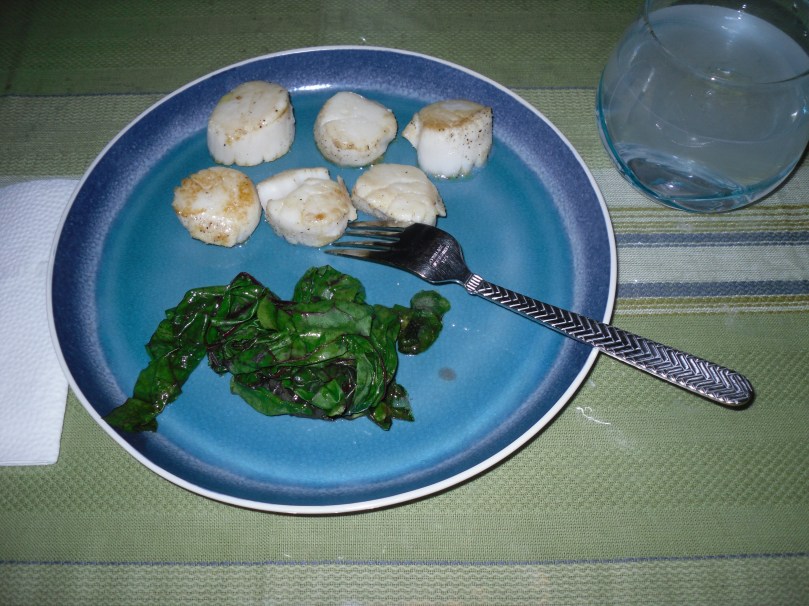
The photo below shows one dinner with local dry sea scallops and red chard. You can simply heat up olive oil in a saute pan and cook the red chard until it’s wilted yet not too dark. The sea scallops can be cooked for five minutes on each side with a little salt and pepper and garlic powder.

Here’s a nutrition fact you might not know: scallops are a good source of Omega-3 fatty acids. And the red chard–well greens in any form are always good.

This dinner is quick and easy: it takes only 10 minutes total to cook the items.

scallops red chard


Pantry Staples

In the book What the Fork? Stefanie Sacks lists common food items and where and for how long you can store them. In Real Simple magazine a number of years ago it featured this kind of cheat sheet in a more detailed fashion.

This got me to thinking what kind of contemporary healthy kitchen a person could stock to make it convenient to eat more nutritious food. Ideally, on nights when you’re too tired to cook there should be better alternatives to some kind of soggy sugary flakes cereal.

Indeed: it’s been years since I’ve resorted to having cereal for dinner. You can click on the recipes category to find simple to prepare meals that can stand in for that ubiquitous cereal-for-dinner lassitude.

See if having on hand these staples would make it easier to cook more healthfully and also when we’re low on money:

Refrigerator:

Eggs – 1 month.

Butter – will last 3 months unopened and 2 weeks opened.

Sesame oil – will last 6 months

Maple syrup – will last 1 year opened.

Mustard – will last 1 year opened.

Deli olives  – will last 2 weeks.

Broth – will last 4 days.

Salad dressing – will last 1 month.

Pasta sauce  will last 4 days opened.

Pantry:

Honey – will last 1 year opened or unopened.

Hot sauce – will last 2 years.

Onions and garlic – will last 2 months.

Canned beans – will last 9 months.

Pasta – dried – will last 2 years.

Olives – jarred – will last 6 months unopened.

Pasta sauce – will last 9 months unopened.

Vinegar – will last 1 year opened – 2 years unopened.

Olive oil – will last 6 months opened – 1 year unopened.

(All other oils should be stored in the refrigerator. They can keep in a cool fridge for 1 year.)

Salad dressing – 1 year unopened.

This is good news because if you stock a pantry with these items you can buy salad greens and then use the olives and salad dressing and chick peas or other beans in the pantry to create a salad.

You can also use the eggs to create my Baked Eggs in Tomatoes recipe. (In season in the summer or out of season at other times.)

I’m not going to judge a person who eats meat. I’m not going to judge a vegan either. Each of us has to do what makes sense for us. A lot of the information I’ll be writing about was gleaned from What the Fork? by Stefanie Sacks.

I’m not going to say “read it and heed it” for anything I write or what I refer to from a book. I’m simply like a librarian giving information.

You can see if it makes sense.

I write about fitness and nutrition now because it’s high time someone living in recovery came out and wrote in specific detail about these things.


Fifty and Beyond

I turned 51.

Fifty and beyond can be beyond measure.

I’m confident when I tell readers that life can get better as you get older.

It’s time to discard the old, the outgrown, the outdated.

Life demands that a person is open to what is possible for us at mid life.

I have a guy companion now. He appeared in real life like a soul mate. Not by checking off a list of traits on an Internet dating website to see if a guy matched every criteria.

Those guys’ photos on OKCupid look like mug shots.

The point is not that your soul mate has to be a wife or husband or other romantic partner.

I’m writing another book and in it I talk about a book at a library that talked about women’s sexual fluidity. I haven’t seen anywhere else on the Internet or in the mental health literature or in any other blog or in a blog featured on PsychCentral or elsewhere talk about sex and relationships in this kind of detail.

What’s often commiserated about is the idea that so-called normal people you take on a date think you’re “crazy” when you reveal you have a diagnosis. That’s so over.

Sex and relationships and talk about these things doesn’t have to be brought back to relating to the diagnosis if you don’t want it to.

What’s not talked about and should be is how income limits a person’s options more so than anything else.

Some women judge men by their ability to take them out for a 3-course steak dinner that costs at minimum $60 dollars. A friend had a woman chew him out because he didn’t take her to a high-end restaurant that cost at least $100. She thought the $60 he paid was too cheap. How offensive is that chica if you’re doing that–I think very.

Finding someone who’s compatible is not easy for a lot of us and it often has nothing to do with having a mental illness. If you’ve browsed OKCupid lately you’re aware there’s plenty of fish in the sea however most of them you wouldn’t want to swim near.

Becoming obsessed with finding a boyfriend or husband and settling for the wrong guy is a mistake.

At 50 and beyond we have the power–and women too have the power–to choose to focus on our heart’s desire.

Which for some of us might be walking down the alter and for others might be staying at home knitting a sweater.

I was supposed to write altar in that last sentence. Though alter can describe the kind of life some of us live.

I have seen no one else talk about this fluidity anywhere else. I have seen no one else talk about how income limits a person.

I have only seen in one other place a writer make the case for finding your true soul mate.

It was in the March 2016 Oprah magazine where a feature article talked about how a soul mate can be a friend or even a sweater or other article of clothing or a work wife or work husband as the expression goes.

It is time to talk about these things. It’s time to dispense with the usual discourse. It’s time to talk about having the courage to do your own thing–whatever your thing is–without fear of reprisal.

And if you don’t want to talk about illness except in a bare-bones way to the people you meet I say: go ahead–be discreet.

Judging other people is a crummy thing to do yet all too often it goes on and more so against people with mental illnesses. For reasons that are totally arbitrary.

Which is why I think each of us needs at least one soul mate who gets us on a divine level even if it’s not a physical level.

Inspiration for Living in Recovery

I have a friend/companion. We sit at an outdoor patio. We go to Starbucks. We attend poetry readings.

Wherever we go the talk often turns to recovery. Not a lot of people would be so open in places where others can hear you. It’s refreshing–and-life affirming–to have a companion in an almost soul-mate kind of way.

I firmly believe a soul mate doesn’t have to be only a wife or husband–a soul mate can be a member of your tribe. We talk about the Sonic Youth albums in our collections. Everywhere I go I’ve met someone entranced with the music.

I value that illness holds only a minor place–because I choose to focus on the life that is possible after a break. I’ve lived through the worst– I recovered.

A woman on the Internet who uses a fake name didn’t understand why I identified as a person diagnosed with schizophrenia. I identify as a person who had a breakdown–what’s commonly diagnosed as schizophrenia.

Yet the point isn’t that once you’ve recovered you should go your merry way. By all means: only if you want to go your merry way do so without guilt.

I decided to become a mental health activist because of the cost of untreated mental illness in America–upwards of $192 billion. I’m an activist because of the untold cost in wasted lives–in the loss of human capital.

Everyone deserves to have a full and robust life–not just a lucky few who get the right treatment right away. I advocate that you can have a full and robust life because no one who has crossed over should despair that they can’t come back.

I advocate–and I always will–for recovery for everyone.

Dr. Martin Luther King Jr. is quoted:

“Everyone must decide whether to walk in the dark of destructive selfishness or live in the light of creative altruism. Life’s most persistent and urgent question is: what are you doing for others?”

My goal in this lifetime is to be an inspiration.

Your hell doesn’t have to go on forever.

Making Changes at Mid Life

The takeaway–the life lesson– is that our lives aren’t over until God says they’re over.

Finding our right work–vocation–livelihood is like trying all the keys on a chain to see which one unlocks the door to true happiness.

Readers: I failed big time at a lot of things. I spent five years in the gray flannel insurance field just starting out–that’s my number-one infamous claim to having failed.

Getting to mid life gives us the chance to reexamine our path. It’s not ever too late to take action in the direction of our dreams–or in the direction of a new passion that arrives later in life.

I went to graduate school with a woman in her sixties–yes, she was going to school at 65!

I say: risk change–believe in tomorrow. I will talk soon about how one daring act when I was 46 totally turned my recover around for the better.

It’s not ever too late to make a positive change and see results.

Fifty and beyond is prime time.

I’ll tell readers now and always: set your sights higher. As best you can, refrain from believing anyone who tells you there’s no hope that your illness can get better.

Our lives can change for the better at any point along the way.

In the next blog entry I’ll tell you how I’m confident beyond a doubt that this is possible. I’ll talk about how other people have made this happen.