Having It Your Way

In the 1980s Burger King advertised that you could “Have It Your Way” with their hamburgers.

The special sauce for living life today I dare say is deciding for ourselves what kind of lifestyle is the best one for us. It might not be what others tell us is the only “right” way to live.

This comes down to having the radical grace to accept that none of us is infallible or perfect. We won’t always do what’s in our best interest. The goal is to create a lifestyle that is optimized for our own version of health wealth and happiness.

My definition of health is not going to be the same as yours. Nor is your kind of healthy going to be the same as another person’s.

For a so-called expert (as opposed to a credentialed expert) to tell us there’s only one “right” way to be healthy is what I’m here to counter.

A recent secondhand experience got me to see that in the throes of illness there can be inside a person a version of wellness. However ill that person might be they can live resilient.

We need to expand what constitutes health when so many of us have chronic health conditions. Isn’t it possible to feel good despite with and because you’ re living with a medical condition?

In what ways can each of us feel good should we live with any kind of limitation on our health? This is an area I want to explore in this blog. With an array of ideas re: “how-to” have that full and robust life when in the throes of a health issue or other setback or kind of challenge.

Let’s face it: Who among us can really live up to any other person’s expectations let alone an expert’s? Each of us is our own expert on our life.

This is not an endorsement of going AMA or against medical advice that is sound and proven and we’re asked to follow. No–do what the doctor ordered when it has the potential to cure you or alleviate your condition.

What I’m against is trying to live up to an impossible standard re: what is the only right way to live our lives. I for one couldn’t work in a corporate office for example.

The same goes re: having those chips every so often. Being okay when we’re not up to par or are not feeling up to par.

In the current climate of “scarcity” it should be reassuring to know that we have enough and we are enough.

In this coming winter of hibernating and some of us having SAD or seasonal depression this comes down to figuring out where we want to use our energy and what we want to devote our time to.

Coming up a question I was asked that I think can be the springboard for finding out the right course of action. The question posed to me was a game-changer.

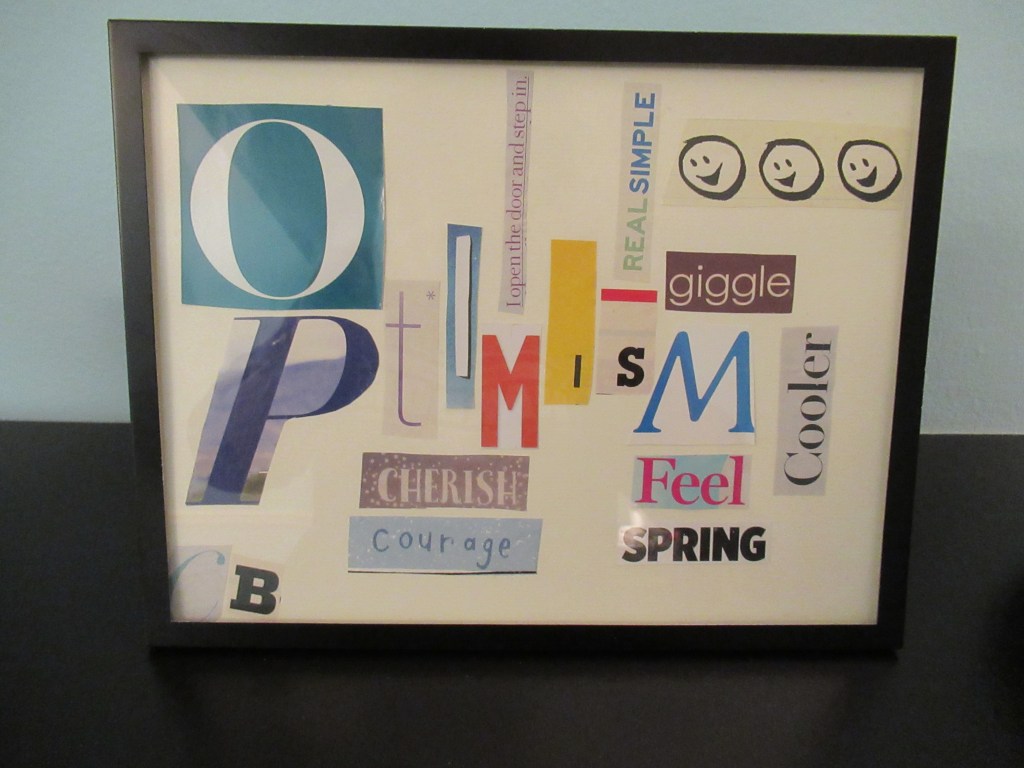
Having Optimism

Optimism is called for.

I created the collage above at an adult art workshop at a library.

I was inspired to spell out the word optimism in letters after I read in a personal finance book that people who are well-off or acquire wealth tend to share the trait of being optimists.

This seems far-fetched to me today. I’m an optimist and I’m not a millionaire.

Far from this–and I think a lot of other people are in the same sinking boat in today’s economy.

Why do I think optimism is called for?

The belief in a better future for ourselves is what will get us through this lingering COVID-19 outbreak which has not gone away in America.

I’m an incurable optimist in that I think people can recover from this pandemic setback that has brought uncertainty to everyone’s lives.

If you asked me why I believe that a person can recover–from an illness of any kind mental or physical–from any kind of setback or challenge I would tell you:

It’s because I think people have the power to choose how they want to live their lives.

People in recovery have control. This is what I think. For others to claim recovery is not possible they are insinuating that you are helpless to control the direction of your life.

Only you and I are in the driver’s seat. We’re the ones steering the wheel down the road of our lives.

And even for those of us who will always struggle who will continue to have a severe illness–I maintain that they can have a life of purpose and dignity.

Everyone living on earth is doing the best we can with what we were given.

Compassion is called for as well as optimism.

Giving up or giving in when you can’t see the light at the end of the tunnel is a mistake.

You keep walking and walking until you see the light.

I believe the future will be better. I believe that light is coming for us all.

Taking a Detour

My life changed forever in one night in 1987 when I was 22.

I had to take a detour that lasted for 13 years. You got that right–13 years.

In light of the COVID-19 pandemic I want to talk about taking a detour.

Let me tell you a detour is not a dead-end. It’s a pit stop along the way to a different path.

Maybe you’re not supposed to get what you want quickly and painlessly.

That is the goal as I see it–to embrace the struggle for what it is– a learning of something you need to know in order to get what you want.

I care a lot that in this pandemic everything seems to have been put on hold. A sunny day can be harder to envision.

I would say my life didn’t get better until I turned 35 and started my library job and moved to Brooklyn.

Sometimes where you start out isn’t where you should remain.

That is the ultimate purpose of a detour: to cement in your mind the one true path you must go down to be happy and fulfilled.

You don’t often figure out until you experience firsthand a setback the truth about who you are and where you should be going in life.

Again–I think of these things during the pandemic we’re living through. Of how it can seem like this is the end of everything–the end of your hopes and dreams for whatever you had hoped to achieve.

I say: use this time to engage in active reflection.  Get out a notebook and sketch out what your goals will be when the pandemic is over.

Shore up your good feelings while you shelter in place.

Remember that after things get better there’s so much life for all of us to live.

Having 5 Commitments

Easily over five years ago I read a Leo Babauta book where he told readers to list their 5 Commitments in life.

This approach made great sense to me. In the spirit of talking about recovery I want to riff on choosing and committing to 5 areas.

Do this for the sake of your mental health and physical well-being first of all.

As I head into my fifties and go through changes at mid-life the benefit of having 5 Commitments resonates with me more than ever.

It’s called a routine: adopting healthy habits that you engage in every day or every week.

This isn’t to say that the focus of your life won’t ever change. As you get older, you’ll need to improvise as you go along.

I find myself at 53 engaging in a form of woodshedding, which I talked about in one of the first blog entries in this Flourish blog.

While isolating inside because you’re afraid to go out your front door isn’t healthy I say:

Enjoying your own company when you’re alone in your apartment or house is imperative.

As I’ve started journeying through mid-life I can vouch for the positive health benefit of needing more time for yourself to rest and engage in recreation.

You need to rest after going out socially or having a long, hard day at your job.

The key to maximum productivity in your personal life lies in the beauty of honoring your 5 Commitments.

My 5 Commitments are art, music, fashion, books and writing, and exercise.

Making time each week to do something involving these 5 things I love has been the way to feel healthy and be happy at mid-life.

What are your 5 Commitments?

In coming blog entries I will continue with the focus on careers.

Yet I will apply this wisdom to everyday life.

Living in recovery doesn’t have to be so hard. Even if you’re in pain that’s when doing the things you love can help you feel better.

That’s it exactly: focusing on the 5 Commitments that bring you joy.


Who You Are Versus the Pills You Pop

I’ve been thinking long and hard about the topic of personality.

About how a person’s soul is animated in their body and embedded in their brain in this particular lifetime.

We cannot confuse a person’s symptoms and illness with their identity and individuality.

That is the root of what’s called “stigma”–stereotyping everyone with a mental illness based on one person’s behavior.

In fact, stigma isn’t often linked to observed actual behavior. Just to popular opinion of what it’s like to have an illness. Which is fueled by the media.

I’ve been an Activist–a Mental Health Advocate first of all–for over 17 years so far.

My stance is this: anyone who chooses not to see another person as an individual is blind.

I’ll quote from an e-mail I received:

“Those who judge don’t matter and those who matter don’t judge.”

I say: “Break bread” with others to get to know them at their soul level.

The sad fact is for too many people those of us with a mental health diagnosis are seen as an interchangeable homogeneous entity.

It’s why I refuse to divide people–either along color lines or the line of having a mental illness or not having one.

In the end, it’s simply lazy and ignorant to stereotype a person, as if they are not worth getting to know for who they are on the inside.

The truth is: our personalities are as individual as our thumbprints.

Which is the root of why I wanted to write and publish a memoir that told a good story about real people living lives apart from their illnesses.

There’s no other first-person narrative like my book Left of the Dial.

As said I’ve been thinking long and hard about how the individuality of a person diverges from their symptoms.

Who You Are Is Not the Pills You Pop.

Add the chemical cocktails we imbibe to the mix and this doesn’t alter our personality.

I want to shake the haters and ask:

“What’s up? Can’t you see that everyone is beautiful? Why are you labeling people you haven’t even met?

Why are you closed off to opening your eyes to the diversity of human beings at the soul level?”

I tell you:

Imitation isn’t the sincerest form of flattery. It’s the quickest route to ill health.

Be brave. Be yourself.

That’s the foolproof  recipe for success in recovery.


Giving Stigma the Boot

This discovery just in:

I figured out why most people don’t understand you.

Their lack of compassion comes from a place of hurt.

Think long and hard about their envy, their critical nature, their attacks.

Doing so you’ll most likely find they feel threatened.

You’re able to have or do something they can’t have or do.

Be empathetic; be ethical in how you interact with these and other people.

Yet remember: you are a person of worth equal to others in society.

You are worthy, regardless of whether you’re in remission or not.

You are a human being and are entitled to be treated with dignity.

Are you struggling? When will this end you might think.

It’s foolish to assume that other people have it easy. You don’t know what’s going on behind their closed door or in their head.

I say: try to have compassion for people who don’t seem to have compassion for you.

One day they could be tested by getting ill. Then suddenly they’ll be clamoring for a way out of pain and for others to understand.

I’ve said it before in my blogs and I’ll say it again: the role of stigma in impeding what a person can do is overrated.

I’ve thought long and hard about how to bounce back from rejection. About how to feel good about yourself when it seems other people don’t understand what you’re going through.

Meet me in the next blog entry for info on how to soldier on in the face of the heavy artillery of other people’s hurtful comments.

They just don’t understand. Get it? I no longer expect outsiders to understand what it’s like. We can’t expect the impossible from other people.

We can only expect ourselves to do the best we can with what we’re given.

I choose to make a lemon meringue pie out of the lemons life throws.

We’re All Winners

Unlike the disability rights crowd I’m content to use the word “courageous” to describe what it’s like waking up every day and having to live with an illness whether chronic or in remission.

As a fifty-three-year old woman, I don’t think anything or anyone is normal in this world. One day I simply couldn’t get out of bed again. So I stayed home.

Yes, I tell you: give me some kind of prize for having had a breakdown. Call me courageous even though I recovered and I’m in remission. No one should have to deal with an illness every day of their lives regardless of whether or not they still have symptoms.

First of all, folks, it’s courageous to practice wellness in a climate where others want the right to choose to be ill. Only the ill times were no joke for me.

My belief is that you can find your kind of wellness within your illness even if your condition is more severe.

I’m not going to minimize or discount the pain people are in. Nor do I want others to gloss over the pain I’m in. Though I report from the land of Well and Plenty I didn’t always have this fertile tilled soil. It’s too darn hard to get where I’ve gotten that you bet I expect others to have compassion for all of us.

We cannot live our lives in mortal fear of emotionally clueless people who have no compassion for us and our trials. That’s why I say: give us some kind of Nobel Prize just for waking up and being able to go out the door in the morning.

Whether we’re still in pain or doing better isn’t the point. The exclamation point is that each day we’re trying our best to survive and thrive.

We’re winners just because we get up in the morning.

Dancing in the Rain

Fashion ultimately can’t cure an actual disease–if it could Kate Spade would still be alive.

When life isn’t going your way, when a setback happens or it takes longer to get what you want: I say do what makes you happy so that you can feel good.

The solution to experiencing a setback might just be to shift your focus and do something else. Or to change the method you employ for achieving your original goal.

It’s ironic–and sad more than anything–that Kate Spade could design pocketbooks that put a spring in women’s steps when we carried them. Yet she didn’t feel the same joy in her own life.

Was she 55?

I’m a 53-year old woman who hasn’t gotten what she wanted: a boyfriend and a book contract.

The quote gets it right about learning how to dance in the rain instead of simply waiting for the storm to pass.

I recommend that all readers–men as well as women–do what gives you joy.

Readers: dressing in style has been my way to dance in the rain.

This is what I’m saying: that at 53, at even just 22, at whatever age you are:

I submit the goal is to feel good about yourself and your life.

For one person, singing in a choir might make their heart beat. For another, running a 5K marathon might keep them smiling.

The pursuit of happiness is not a frivolous endeavor.

I regret there’s a backlash against the positive psychology movement that Martin Seligman started years ago.

If you ask me it’s imperative that we find out what makes us happy and go do that.

The beauty is that the older you get you can discover new gifts and passions that will bring you joy.

It’s not ever too late to make a change for the better.

The rain can end at some point. For some of us it might continue. That’s when having a fallback option makes sense.

Years ago I went back to school to get a Masters degree. That was my Plan B.

Choosing an alternative path to go down isn’t settling for less. It’s being realistic when it turns out the umbrella you were holding up has broken.

There is always going to be rain. While most of us prefer the sun the rain might serve a purpose too.

Learning how to dance in the rain sure beats being afraid of the thunder.

Mother’s Day Message

This is a Mother’s Day greeting to every women reading this blog entry. It’s thought that all women are mothers in some way taking care of other people.

My mother turned 80 this year. I’m 53 now. In 1987 when I was 22 I was diagnosed with schizophrenia. My mother had driven me to the hospital within 24 hours of my breakdown.

This greeting goes out to every mother whose adult children and or the mental health staff have blamed them for what happened to their kids.

Ever since I decided to become a mental health Advocate in 2002 – over 15 years so far – I’ve credited my mother’s one courageous act to drive me to the hospital as the number-one reason I recovered. Recovered with an ed at the end of recover because of my mother.

I will go to my grave championing getting the right treatment right away when a person first experiences mental or emotional distress.

My mother isn’t well. For 40 years she smoked two packs a day. Though she quit when she was 61 it was too late to prevent smoking-related disability. She has emphysema because of her addiction. Today she sleeps and travels everywhere with an oxygen tank.

Though I’m the one diagnosed with schizophrenia I’ve become my mother’s caregiver. Unlike how a lot of mothers are the caregivers for their adult kids with schizophrenia.

No one at mental health organizations like NAMI talk about this reverse dynamic: how adult children are becoming caregivers for their parents. Hell NAMI isn’t even addressing the mental health needs of senior citizens living with mental health issues.

What will happen after our parents are gone and we have no one to care for us?

I’m fortunate that I’ve recovered and have always been independent. I will continue to be fit and active because of my own efforts.

Yet what will happen to people diagnosed with schizophrenia who can’t care for themselves after their parents are gone?

What will happen to our parents if we can’t care for them when we’re older?

Nobody’s talking about this. Not NAMI. Not anyone else.

Over five years ago I first wrote about geriatric psychiatry when I was the Health Guide at the HealthCentral schizophrenia website.

Back then I was a pioneer in writing about this. Today I’m still a lone wolf crying out about senior citizens with mental health issues.

We need to think about the passing of this health baton. We need to get real and start talking about the services and supports available to people with schizophrenia and other illnesses that are becoming senior citizens.

We need to talk about the reality that soon those of us who are caregivers will need someone to take care of us.

I’ll end here by sending every women reading this blog entry words of compassion, appreciation, and gratefulness for all you do.

You’re Not an MD So Stop Giving Medical Advice

Chris Bruni is not an MD. I refuse to give medical advice.

Telling someone to discontinue their medication and offering a method to do so is practicing medicine without a license.

I’m not here to tell people what they should do. The story I tell–the only one I have to give–is my story. I can and will talk about how taking the SZ medication every day enabled me to be in remission for over 25 years so far.

A friend of mine who doesn’t have SZ I consider to be my soul mate. He discontinued his psych medication under supervision and is perfectly fine years later.

What gladdens me is that although he’s been successful he doesn’t give people medical advice. He thinks most people with SZ need to take medication.

My friend hasn’t attacked me–like so many anti-psychiatry folk have done–for choosing to take pills.

I want to be very clear to readers now: telling people they should discontinue their medication is practicing medicine without a license.

At this point I won’t even tell people they must take medication because as said I’m not an MD.

We can only share our stories with each other. It’s up to each of us to decide what we want to do.

If someone asked me I would tell them that I think discontinuing SZ medication is too risky to chance it. That’s my belief and my friend’s belief.

You can decide for yourself if this makes sense to you. You have the choice.

Yet I also think that choosing psychosis over health is a big mistake.

No one I know who discontinued their SZ pills got better. They started hearing voices again. (I’m lucky I didn’t ever hear voices.)

Yet even stating this I cannot tell you or anyone else what to do or how to do it.

I urge you if you’re a paid peer specialist as your job not to dispense medical advice without a license. You’re not an MD. You’re not licensed to diagnose and treat illnesses.

In the coming blog entries I’m going to talk about practical career information again.

My goal is to publish You Are Not Your Diagnosis in October 2018 which is Disability Employment Awareness Month.