Risking Change

About five weeks ago I attended a Zoom event that the Roadmap Coach Christina Bryan hosted. She talked about her method of creating your Personal Brand. In my view it’s the simplest most effective way to sell yourself.

Her pitch to obtain clients was that she helps women succeed despite their fear. Fear of change is a big issue for everyone of any identity. So too internalized shame stops us in our tracks. Feeling shame keeps us stuck and unable to change.

The writers given a platform in the media who attack readers I call the media darlings. A person who is made to feel guilty won’t be motivated to change their behavior. Attack someone and their natural response is to get defensive.

I’m struck with how fear and shame prevent us from reaching our potential. Our old habits might have served a purpose. In the light of today when we know it’s time for a change we can be afraid of making the change(s). Since the old way of life has become comfortable.

This has implications not only for our health and wellbeing. It prevents us from having the confidence to express who we are and what we stand for. This is where internalizing the shame others impose on us keeps us afraid to speak out and celebrate our worth.

I don’t know about you followers however I’m done with making myself small so that others will approve of me and feel better about themselves.

The media darlings–and any others who hate judge fear and shame us as a way of life–would be out of business if we stood up straight and stared them in the eye and said: “Look in the mirror not at me.”

The Personal Brand I want to sell is linked to the goal I have that peers can establish and sustain health, wealth, and happiness after facing illness, trauma, or injustice.

I’m not going to cut people down. My aim is to give everyone a shot in the arm of confidence to go after our goals with gusto.

The way to conquer the fear is through action. To act despite the fear. To keep taking action. Especially when the naysayers shoot down what you want to do. Tell you that it’s impossible. Or that you should stay where you are because you’re full of yourself and too big-headed.

Be proud of yourself. That’s what I say. It’s no sin to have pride.

Coming up my ideas on how to sustain change after you’ve gotten the courage to risk doing this.

My hope is that through my blogs I can create a Beautiful Community of followers. To entertain readers not just educate and empower you.

We’re going to live on earth too long in reality to harbor ill-will towards others. Too long to castigate ourselves for imagined faults too.

The Joy of Ritual

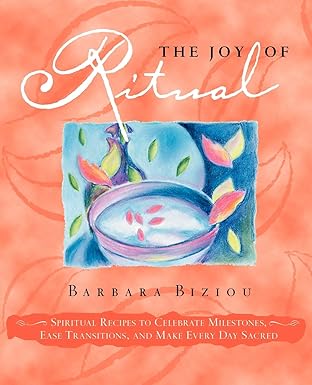
In this blog entry I want to inspire followers to make a positive shift when our life has been derailed on the old track. It was synchronicity not an accident that I checked the above book out of the library. Liking it so well that I bought a new copy from an Amazon reseller as it’s out of print.

The guide The Joy of Ritual teaches readers how to create and use these rites. The subtitle is Spiritual Recipes to Celebrate Milestones, Ease Transitions, and Make Every Day Sacred.

Struck I was by how a workout can be a ritual. An exercise routine is a sacred act not just an expression of physical prowess. Creating a new weightlifting ritual eased my transition into working out again after the arm injury.

As a form of prayer, I wear a cross around my neck while lifting. Not a Catholic cross–I think it’s a Celtic cross. Saying an actual prayer before I lift the first dumbbell. To invoke the ministration of God to “Bless my body. Give me the energy to go about my daily routine and the health to achieve my goals.”

Intertwining the sacred and the spiritual into everyday life with the commercial and material aspects of living our lives benefits us. Though this kind of daily devotion can seem “woo-woo” it’s a dose of positive mental medicine.

Creating a ritual or two can help us heal and recover. This I found out when I started to lift weights again. Redesigning how I exercised was the gateway to better health.

The idea of using a ritual appeals to me as a form of practicing mindfulness. To enjoy each moment before it goes by.

In fact going in a slow and steady rhythm is called for. Rushing around engaging in nonstop busywork every hour of every day is not the way to live.

It can be hard to change what’s not working even when the change would be positive. My goal in here is to encourage and motivate followers to try. Simply try. See what happens. Like me you might be surprised at how well things turn out.

Keeping a Grateful Journal

While others rail against keeping a grateful journal as a form of self-care I’m all for this weekly thanksgiving practice.

Research indicates that writing down what we’re thankful for can alleviate sadness.

My recommendations:

Buy one of the spiral-bound colorful-cover hardbound journals you can get in Rite Aid or even in the aisle at Kohl’s waiting in line.

Write in the book 3 times per week. Before you write a new entry read the last 3 to 5 entries to get you going.

Instead of simply listing what you’re grateful for list Why you’re grateful for this blessing.

Write things you like about yourself too. Write what brings you joy as well. Go further and write about specific achievements.

Remember: ordinary actions taken are worthy of documenting in the journal not just “superstar” accolades to give yourself.

Practicing gratitude is a way to build self-esteem regardless of your life circumstance at the time.

Sustain-Ability

The photo above is of a “continental breakfast”-style dinner.

I’ve taken to making this meal when I have no energy or desire to cook and then clean dishes pots and pans.

Food items:

Mary’s Gone Crackers gluten-free crackers.

Black seedless grapes.

Driscoll’s organic blackberries.

Cento olives in the yellow can.

Grillies halloumi cheese.

Have no idea if this is a healthful dinner.

What I’ve come to realize is that sustainable habits like a weekly routine should sustain our ability to thrive as human beings living in a society where the scarcity mentality is alive and well.

We shouldn’t view things in terms of competing with each other to get what we need to survive.

To sustain our ability to live life whole and well I think adapting and being flexible is paramount.

So take having that weekly routine:

In some weeks we’ll be cooking our dinners 4 or 5 times a week. In other weeks we’ll need to find quick-and-easy meals to prepare because our energy is shot or we don’t have the time to cook and clean.

Before we can save the planet we need each of us to attend to our own health and well being.

That’s because we might live on God’s newly green earth down the road. Yet if we don’t have the health to enjoy our time here it’s likely going to be harder to feel good about ourselves.

I eat well to feel well.

With the summer heat coming on I’m all for making dinners that don’t require using the hot oven. A way to save on your gas or electric bill too.

Sparking Joy to Live Longer

I had COVID for exactly two weeks. Though a mild form it was terrible to live through. A friend told me that because I exercise and eat well this was most likely why I had only a mild form.

What got me mentally energized when my body was slowed-down was binge-watching Sparking Joy with Marie Kondo on Netflix.

In a burst I tidied up my desktop and desk drawers. I placed in a donation bag a small wooden box that hung out atop my desk for 11 years.

The tidying up was life-changing. It led me to want to adopt atomic habits like James Clear wrote about in his book Atomic Habits.

The trick is to tidy up every evening instead of letting tasks and objects pile up in your household.

If you ask me Marie Kondo’s clutter-control method is the only one a person should use. This Japanese tidying-up guru is not only transforming her clients lives and relationships. She might be improving their health.

A Health magazine special edition titled Living Longer the Science of Longevity has an article titled Fastidious Forever.

The mortality risk drops 35% for highly meticulous people according to research.

To wit from the article written by Marta Zaraska:

Fastidious people also have a better relationship with stress. They often thrive when life feels controlled and stable–think structured days and a relatively predictable future.

Science reveals that people who are good at meeting deadlines and maintaining tidy surroundings can have lower levels of the stress hormone cortisol, which has been linked to a litany of afflictions from diabetes to cancer to heart disease.

When hardships do happen, neat freaks tend to cope better.

Inflammation may also play a role. “People who are more conscientious have healthier inflammatory profiles.” According to Angelina Sutin, PhD.

They tend to have lower levels of interleukin-6 and C-reactive protein, common markers of inflammation.

Interleukin-6 and C-reactive protein have also been associated with severe cases of COVID-19.

Did I have a mild form of COVID because I’m a neat freak 🙂

I rest my case: Marie Kondo is actually improving the health of her clients.

Watching Kondo’s clients pile mounds of clothing on their beds to assess what to keep and what to toss I felt better.

It’s because though I’m a Fashionista I own nowhere near half the amount of clothing Kondo’s clients had clogging their numerous closets.

In the coming blog entry I’m going to talk about adopting atomic habits.

Binge-watching Sparking Joy with Marie Kondo I realized the solution is to not let things get out of hand to the point of being overwhelming.

Dumping clothes everywhere could cause a person to feel “down in the dumps.”

As I can attest when I tidied up my desktop and desk drawers I was energized and had more hope for recovering from COVID.

Summering in Place

The COVID-19 outbreak is still in effect.

New York State has gone from having the highest number of cases to having the lowest number of infections as of today.

Where I live in Brooklyn people walk outdoors with open faces not covered with a mask or bandanna.

I walk far far away from these yahoos to get where I’m going.

It’s going on four months that everything shut down around here. We are now in Stage 3 of our reopening.

In this time I have achieved my goal using the Changeology 90-day action plan. My new goal is to cook my own dinners 5x per week.

I would like to talk in the next blog entry about imposing a structure on daily activity and automating a weekly routine.

Has anyone else found like I did that during the pandemic when you’re indoors you have whole chunks of time with nothing to do?

I would like to talk in the next blog entry too about what I’ve learned living through this pandemic.

More Ways to Get Energy

Today more than ever it’s imperative that we take care of ourselves.

Engaging in protest could drain us of energy. We don’t have time to wait to see progress. Today everyone’s tired of being told to wait. It takes a lot of physical stamina to march in the streets.

On the radio this week the disc jockey told listeners to take care of ourselves.

Each of us is possessed with a power bigger than our pain.

Yet sometimes the pain we feel–whether about injustice or our own illness or other things–can be overwhelming.

What do I think about how to take care of ourselves?

It comes down to conserving our energy for the tasks that are essential. Letting everything else slide.

I wrote in here recently about how to get energy. A Real Simple issue titled Find Your Balance has an article on The New Rules of Eating for Energy:

Eat protein for breakfast.

People who have a high-protein meal of about 30 grams first thing in the morning with low glycemic load food had the highest energy level.

Drink plenty of water.

I wrote about this in my last blog entry on getting energy.

Fatigue sets in when you get dehydrated.

Have a healthful snack during the day that has fiber protein and healthy fat.

This could be a handful of almonds or cashews or walnuts.

Eat more calories earlier in the day.

You have a food circadian rhythm. Having a moderate-sized meal for breakfast and lunch and a small meal for dinner could be the way to go.

Nix sugar as a source of energy.

After the initial blood-sugar spike you’ll be left drained.

Dine with friends.

As per the Real Simple energy article:

Social interaction has been shown to help people manage stress pain and sadness all of which are drains on energy.

There is a cookbook titled Protest Kitchen.

If I remember it caters to vegan recipes. You might be able to check it out of the library where you live. It’s available from the library system in Brooklyn NY.

Theme for This Blog Going Forward

My goal in this blog has become to act as a motivational speaker in print.

I envision my blog as being a safe space on the internet to promote what I value:

Living in health harmony and happiness with yourself and others.

Most likely I have written in here before that I value fitness of body, mind, spirit, career, finances, and relationships.

As I remain mostly indoors while living in the epicenter [New York City] of the pandemic I’ve decided to continue to write motivational blog entries.

I choose to cater to a target market of people coming together to honor, accept, and embrace each other’s individuality.

I choose to serve a target market of individuals who want to be healthy, wealthy, and wise in the ways that count.

I choose to use my life experiences and accumulated wisdom to educate, empower, and entertain a target market of people who seek to heal what’s not right in society:

Namely, the corrosive hate and judgment that reinforces stigma and makes it impossible to heal from any kind of ill-ness.

My focus will be on ideas I have for achieving mental and physical health.

In the next blog entry I will talk some more about the six categories of fitness talked about above.

Living in the Epicenter of the Pandemic

I wanted to write about what it’s like to live in New York City–the epicenter of the pandemic.

1 in 5 New York City residents have been infected.

15,500 people here have died from the coronavirus.

58,000 people in the U.S. have died from the coronavirus.

1 million Americans in the U.S. have been infected.

The novel coronavirus appeared in the U.S. as early as late December 2019.

As a person who works with 100s of members of the public everyday I was at a greater risk for far longer than I should’ve been.

New York libraries shut down on March 16. It was revealed that the coronavirus appeared in New York State as early as mid-February.

I was put at risk far longer than I should’ve been. I don’t take this lightly.

Going outdoors I wear a black bandanna. I have a host of 10 red bandannas that I will alternate with the black bandannas.

You have to wash the bandannas frequently after using them.

I find myself gasping for air under the bandanna when I’m walking outside.

Screwed-up are the people who go outside and don’t wear a bandanna.

They’re putting other people at risk of getting infected.

Living through this tragedy in the form of disease I’ve come to a turning point in how I want to move forward writing blog entries here.

The pandemic has changed how I see things.

I’ve become more committed to championing mental and physical health for everyone living on earth.

Taking a Detour

My life changed forever in one night in 1987 when I was 22.

I had to take a detour that lasted for 13 years. You got that right–13 years.

In light of the COVID-19 pandemic I want to talk about taking a detour.

Let me tell you a detour is not a dead-end. It’s a pit stop along the way to a different path.

Maybe you’re not supposed to get what you want quickly and painlessly.

That is the goal as I see it–to embrace the struggle for what it is– a learning of something you need to know in order to get what you want.

I care a lot that in this pandemic everything seems to have been put on hold. A sunny day can be harder to envision.

I would say my life didn’t get better until I turned 35 and started my library job and moved to Brooklyn.

Sometimes where you start out isn’t where you should remain.

That is the ultimate purpose of a detour: to cement in your mind the one true path you must go down to be happy and fulfilled.

You don’t often figure out until you experience firsthand a setback the truth about who you are and where you should be going in life.

Again–I think of these things during the pandemic we’re living through. Of how it can seem like this is the end of everything–the end of your hopes and dreams for whatever you had hoped to achieve.

I say: use this time to engage in active reflection.  Get out a notebook and sketch out what your goals will be when the pandemic is over.

Shore up your good feelings while you shelter in place.

Remember that after things get better there’s so much life for all of us to live.