How to Motivate Yourself

My sincerest hope is that I can do some good in my time here by using this blog as a motivational platform to educate, empower, and entertain readers.

My contention is that taking action sets in motion positive thinking. Which spurs a person to take more action. And so on. Like a peppermint stick thoughts and actions swirl around each other to reinforce goal-setting habits.

This December at long last I followed through on a long-held goal. Meeting a person who had competed in a marathon gave me the kick in the training pants to take action.

Before the holidays at the end of the year I achieved my goal of doing a walk/run on the treadmill 1/x per week. I did this for 4 weeks in a row.

Achieving this simple goal gave me the confidence that I could achieve other goals. Even ones not related to physical fitness.

Executing one goal–hopping on the treadmill–fired up my mental energy and alacrity.

It gave me the chance to think differently about myself and my skills, strengths, and abilities.

Always I’ve seen that by first taking action it leads to positive thinking. The physical act of doing something creates a positive cascade of thoughts flowing in the right direction.

Danica Patrick in her book Pretty Intense calls this your “mind river.”

I realized that I’m an innovative thinker. It’s easier to have self-acceptance.

My ulterior motive in keeping my two blogs is to empower readers to have self pride and to like yourself in a world where there’s still a lot of judging and stereotyping going on.

Living on earth it’s a better world precisely because everyone’s different.

The saddest waste of anyone’s “human capital” is for a person to try to change who they are to get other people’s approval.

I’m done with that. I’m done with caring what other people think.

Set a goal. Use the Changeology 5-step 90-day action plan to aid you in achieving the goal if you want to use this guide. See what happens.

Simply by doing a walk/run on the treadmill I started to internalize the powerful message that what makes me different gives me a specialty.

So too this is for everyone: what makes you different gives you an advantage.

You don’t have to be anyone other than who you are to succeed.

How to Start Making a Change

I want to clear up something in terms of a common mistake people make:

Acting harsh towards yourself–a form of negative reinforcement–only serves to keep you stuck in old thought patterns and behaviors that are holding you back.

Viewing yourself with a compassionate eye is the first order of business when seeking to execute a change for the better.

First, forgive yourself and have empathy. It’s possible that the current behavior manifested as a habit because it originally served a purpose that might have benefited you.

Over time, the need to change could crop up. My strategy is to change as I go along in life rather than waiting until a drastic change becomes necessary.

As regards food and fitness goals and resolutions, this is where each of us needs to be kinder and gentler on ourselves.

Making positive changes is possible when you first psych yourself up mentally to make the change. This is Step One in the Changeology book.

To motivate you to change your thinking, thus improving your ability to change your behavior, I want to quote from the book Pretty Intense. You could benefit from buying the book, which is why I quote Danica Patrick here:

“A study in the World Public Health Nutrition Association Journal found that the increase in ‘ultra-processed’ food–food that includes ingredients that aren’t, in fact, food–may be the main cause of the rise in obesity around the world.”

Isn’t it helpful and reassuring to know that a simple change in our eating habits can have dramatic health benefits?

I’m going to end here with a scenario from my own life to motivate readers to consider making this one positive change.

Exhibit A:  My mother’s eating habits which should hit closer to home for readers.

She snacks, snacks, snacks on cookies, chips, cake, and pastries. She has chocolate Special K for breakfast that contains artificial flavors. The food marketer for this cereal lists on the box that the cereal has “150 nourishing calories.”

I didn’t know that artificial flavors were nourishing. Please step away from this particular cereal box. Or any kind of cereal box.

My mother happens to be overweight and out of shape. I love her with all my heart. I care about her and her health.

The number-one lesson I learned from my mother by watching her is that the food we eat impacts our mental and physical health more than any other factor in our lives.

Making simple, incremental, and lasting changes that are effective is possible.

It doesn’t involve going on any kind of restrictive diet. I never went on a diet, and I lost 20 pounds in my twenties and kept the weight off.

I use my family history as an example to make this point:

It pays dividends to be kinder and gentler on yourself when you first start making changes and follow through on continuing with the new behavior.

Find the things that motivate you to make a change. For me, my family history was the alarm bell ringing in my head.

For you, you might want to change so that you can live to see your kids graduate college.

Or you might want to change so that you have the energy to get out of bed in the morning without feeling tired and cranky.

It can be as simple as this.

Find your specific why you want to change.

Lastly: we need to remove the blame that is the stigma–“a mark of shame or discredit” from the conversation.

Feeling good is the life goal that counts more than anything if you ask me.

And you can control how you feel by changing what you eat. Which is what I did “piano-piano” as we Italians say or slowly slowly.

In coming blog entries I’ll detail the methods I employed that boosted my mood, elevated my energy, and reshaped my body.

My goal is to empower readers to make your own positive changes.

Making Changes

One other thing I did was to start cooking my own dinners again.

For years I had an old regular oven that had to be cleaned using oven-cleaner cans.

The fumes were toxic. It was a chore to use the cleaner.  Food got caught underneath the burners.

In any number of “green cleaning” books there are alternatives to using oven-cleaner cans.

Try The Modern Organic Home by Natalie Wise for starters. It might be able to be checked out of the library.

It might seem extreme yet my solution was to buy a self-cleaning oven.

I’ve cooked my own dinners three or four times a week so far.

I find that when you have a disappointment or two in your life it pays to focus on something else temporarily.

My goal of publishing a career handbook will not happen any time soon.

While I wait to make this happen I want to devote the blog to health topics.

In terms of the mind-body connection food is fuel for your body. Your body is a workhorse that can help you achieve goals.

Without health what does a person really have? Life is difficult when you don’t have your health.

Which is why compassion needs to be given to those of us who aren’t shiny happy people with photogenic Instagram feeds.

My fitness level is linked to my efforts. Yet for a lot of people it can seem like the luck of the draw that they become ill.

We shouldn’t blame each other. We shouldn’t judge each other.

All in all in this Flourish blog I want to talk about mental health and physical health to educate, empower, and entertain readers.

Today’s lunch just might be a Table 87 margherita pizza 🙂

Making Fitness My Priority

I’ve come to make fitness a priority.

Health equals wealth. The true definition of wealth is abundance.

With health you have what you need to achieve your life goals.

Being ill makes it that much harder to succeed.

Over the years through a series of events I’ve come to prize having a fit mind and a strong body.

The mind and body work together to give us optimal health.

I’m 54. Two years ago when I was 52 and started menopause my energy tanked. Would I have to accept that my old energy was gone for good?

My body is getting older. My mind is still youthful.

Could bridging this divide help me get back my energy?

At about the time I turned 52 and started going through “the change” of life as a woman other things happened.

I stopped taking any kind of vitamin or supplement. I had wanted to believe I could satisfy my nutritional needs solely through food choices alone.

This is also when I stopped cooking my own meals for dinner. I relied on boxed frozen food packages that were supposed to be healthier choices.

Folks, I ate a lot of this prepared junk for too long. To compensate, I started ordering food to be delivered to my apartment for dinner.

The restaurant food was healthful yet way more expensive every week.

The remedy came on in April of this year 2019 when on a whim I hired the health coach.

After scrambling eggs and veggies for breakfast for the last six months my mood improved.

By exercising in the morning in my living room 2x per week my body got fitter too.

Last week I wondered if perhaps I could use other help. I ordered Vitamin D tablets from the FullScript link my health coach had sent me online.

I’ve started to take one Vitamin D pill in the morning with breakfast.

Would I see a return to my old energy level or at least an improved energy level?

I was motivated to resume taking a Vitamin D pill after reading the Eating Well special edition magazine Eating for Energy.

This book is a common-sense guide to doing what it says: eating for energy.

I also changed one other thing for the better. I’ll talk about what I did in the next blog entry.

My intent is to give readers hope that making positive changes is possible at any time in your life and your recovery.

You might not be in such great health. As always I recommend the book Changeology: 5 Steps to Realizing Your Goals and Resolutions.

I’ve achieved numerous goals in the last year by using the 90-day action plan detailed in this lifesaver of a book.

In coming blog entries I’ll continue to report on the results I’m achieving by making these small, consistent, incremental changes.

Making positive changes isn’t easy. It’s natural to resist doing what’s in your best interest when it’s easier to adhere to the status quo.

Only I tell you readers: the status quo wasn’t working in my life.

It was time to do things differently. I’ll tell you how things turned out: better than I expected.

Read on for the results.

The Inspired Vegan

inspired vegan

The photo is the cover of a book I bought when it was first published in 2012.

Bryant Terry is a food activist who founded b-healthy in New York City. His goal was to train young people as food educators. To help them buy and eat and advocate for healthful food.

From The Inspired Vegan cookbook I’ve used the Simple Salad of Butter Lettuce and Fresh Spring Herbs with Meyer Lemon Vinaigrette. The book has the recipe for the vinaigrette. You can use regular lemons if you don’t have Meyer lemons.

I recommend this book for everyone not just vegans. I also bought the cookbook Grub that Bryant Terry coauthored.

I realize I had forgotten to write about setting up a home gym 3.0. I had said I was going to write about this. In the next Fitness Friday blog entry I will list a ton of at-home exercises you can do.


Talking About Health

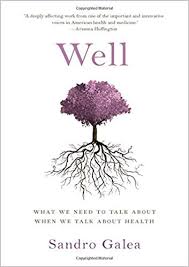
book cover well

The subtitle of the captioned book is What We Need to Talk About When We Talk About Health.

The author Sandro Galea connects the dots that no one else has connected. He illuminates the root causes of health disparities among Americans.

The excess of diet books churned out and published each year expand the myth that personality responsibility causes ill health for the majority of Americans.

As economic inequality increases none of us will be immune from having to choose between buying an unhealthful $6.99 Hungry Man Swanson dinner and picking up fish and vegetables for dinner.

As Sandro Galea brings to light:

“True health comes from social and economic justice. It is a product of systems that create opportunities for all to live a life that is unconstrained by the forces that generate sickness…Health comes from living in a world where no one is walled off from the conditions that allow us to be well from the day we are born until the day we die.”

Alas the preponderance of “food deserts” in low income neighborhoods–the absence of supermarkets selling better food–causes obesity when residents are forced to buy processed food that lines the shelves of convenience stores.

In low-income neighborhoods a lot of people don’t have cars to drive to a supermarket or a farmer’s market that is miles away.

Sandro Galea refers often in his book to the legacy of slavery as seen in the the ongoing racial segregation in neighborhoods where people live.

The proliferation of unregulated gun ownership has caused ill health in these neighborhoods. Having more people own more guns in society doesn’t make Americans safer–it makes us victims of ongoing gun violence–whether by mass shooters or a hoodlum walking down the street.

The book Well by Sandro Galea should be required reading.

The author rallies for having compassion for everyone. He admonishes the Republican and Conservative ilk who use the “personality responsibility” card to attack people living in poverty and  collecting government benefits.

I have the unusual experience [for a person like me] of having received so-called “entitlements” in my early twenties. I collected a government disability check, used Medicaid to pay for clinic visits, and lived in public housing.

In retrospect I can see why I was overweight: I bought hot dogs to cook (cheap!) and Velveeta Mac-and-Cheese (not really healthier even though I added broccoli to it).

You shouldn’t be judged and attacked when you’re forced to choose to buy unhealthful food.

There’s a better way. I’ve written in my blog before that the American healthcare model is foolishly predicated on disease management instead of illness prevention.

As per Sandro Galea health has nothing to do with the ability to buy yourself a cure for cancer. It have everything to do with the environment you’re born into and live in.

Whoever has health has wealth in the true definition of wealth as being abundance.

Read the book Well like I did and you might see things differently as I do now.

My goal is to vote for Andrew Yang a candidate for president whose platform involves giving every American 18 and older a monthly Universal Basic Income of $1,000.

With the loss of jobs to computer automation–with the increasing economic inequality (which is no individual’s fault at all)–I’m in favor of creating a Universal Basic Income system in America.

The jobs lost to computers simply aren’t coming back.

In the coming blog entry I will explore the issue of food justice in more detail.

I will start to give summertime recipes again.


Rebelling the Role of “Mental Patient”

It can seem like there’s a glass wall separating people with mental health conditions from others.

It’s like you can see what’s on the other side–“success” “a good life” “a career” “a home”–and the wall stands between you and getting these things.

What is this invisible barrier? Internalized self-stigma brought on by harboring outdated false beliefs about what a person’s life is destined to become after a psychiatric emergency.

Getting to this side involves breaking free of the shackles of guilt and shame.

What I’ve learned I’ll gladly share here. I want to quote from the Introduction to my career handbook so that you might be convinced of the truth: You Are Not Your Diagnosis:

As a young person, I was happy even though my life was less than ideal. Yes—I chose to be happy even when the circumstances of my life were dismal. You can like I did rebel the role of “mental patient.” You are not your diagnosis. You’re a human being with wants, needs, desires, goals, and dreams just like everyone living on earth. It’s a mistake to think your diagnosis limits you forever in what you can do.

Having a diagnosis is often part of the package you present to others yet it isn’t your identity. Defining yourself by your symptoms locks you into a no-win mental straitjacket. Your diagnosis is not a dead end and it doesn’t define you.

A women’s organization I’m a member of used to ask its members: Who are you?

I say: you have the right to choose your identity.

In a coming blog entry I’ll talk about this in more detail.


Choosing a Job for Love or Money

Choosing a Job for Love or Money shouldn’t be a toss-up.

Ideally, the job you love will pay a livable salary. When it doesn’t you can drum up a “side hustle.”

The book The Economy of You by Kimberly Palmer talks about how to create a second income stream or else create your own full-time business.

Again, using the book Changeology: 5 Steps to Realizing Your Goals and Resolutions can also help.

The Small Business Administration website can give you information too.

Going into business for yourself or working at an established company is possible.

Clearing hurdles will make it possible to do this.

One hurdle is overcoming resistance to getting any kind of job:

Either countering your own internal roadblocks or that of naysayers who claim it’s not in the cards for you to do what you want.

In the next blog entry I’m going to document a better way.

If any social workers are reading this I would like you to take note.

Fitness Fridays

I’ve decided to plan and schedule my blog entries here.

Fitness Fridays will be the theme of the nutrition blog topics.

I’ll post on Fridays blog entries about fitness and nutrition.

The fact is:

Infirmity is not inevitable in old age.

Lifestyle habits are a significant factor in whether you remain healthy or progressively decline into ill health.

A while back in the blog I wrote about the book How to Be Well. After going on the book author’s website, I submitted a form to talk with a health coach.

For a customary fee you can get individual advice. An action plan is created for you to follow. Two weeks later there’s a follow-up talk to see how it’s going.

The fee is actually cheaper than other nutritionists charge. A 6-session package costs more. I opted for the 3-session package.

Folks: carbohydrates are my enemy. After talking with the health coach, I threw out all the grains and granola packages in my kitchen.

My plan involves scrambling eggs with veggies to have with avocado for breakfast. It’s entirely possible that having granola for breakfast had been one of the culprits in my mid-life fatigue.

You can go on the Dr. Frank Lipman (the author)’s website to research the options for talking with a health coach.

I have no guilt in having gotten rid of the grains. Bye-bye.

In one week, I will report back on how it’s been going.

Having 5 Commitments

Easily over five years ago I read a Leo Babauta book where he told readers to list their 5 Commitments in life.

This approach made great sense to me. In the spirit of talking about recovery I want to riff on choosing and committing to 5 areas.

Do this for the sake of your mental health and physical well-being first of all.

As I head into my fifties and go through changes at mid-life the benefit of having 5 Commitments resonates with me more than ever.

It’s called a routine: adopting healthy habits that you engage in every day or every week.

This isn’t to say that the focus of your life won’t ever change. As you get older, you’ll need to improvise as you go along.

I find myself at 53 engaging in a form of woodshedding, which I talked about in one of the first blog entries in this Flourish blog.

While isolating inside because you’re afraid to go out your front door isn’t healthy I say:

Enjoying your own company when you’re alone in your apartment or house is imperative.

As I’ve started journeying through mid-life I can vouch for the positive health benefit of needing more time for yourself to rest and engage in recreation.

You need to rest after going out socially or having a long, hard day at your job.

The key to maximum productivity in your personal life lies in the beauty of honoring your 5 Commitments.

My 5 Commitments are art, music, fashion, books and writing, and exercise.

Making time each week to do something involving these 5 things I love has been the way to feel healthy and be happy at mid-life.

What are your 5 Commitments?

In coming blog entries I will continue with the focus on careers.

Yet I will apply this wisdom to everyday life.

Living in recovery doesn’t have to be so hard. Even if you’re in pain that’s when doing the things you love can help you feel better.

That’s it exactly: focusing on the 5 Commitments that bring you joy.